Thursday, 21 February 2013

MOVING HOUSE

Nothing to do with pop culture or reviews, this is purely a personal piece about why I haven't been posting recently.

I won't go into to detail so suffice to say that my wife and I agreed to split up. Everything has been extremely amicable, we're still friends and see each other every day. It helps that we're both active in animal rescue (see my other blog for details). After not too much looking around I found a house I liked only five minutes walk away which I got for a fair price and, it being in pretty good condition, didn't expect to have to spend too much doing it up. Until I found out it needed re-wiring which more than doubled the amount I expected to spend and postponed the moving in date by several weeks. Of course it wasn't just the rewiring as one thing leads to another but I did end up with a house in very good condition and done out mostly the way Susan, my wife, wanted. I did manage to put my foot down on a few things.

I decided to go with Sky rather than Virgin as comparing prices I got more bang for my buck. What I didn't expect was that it would take another three weeks after the TV stuff was installed before I got my broadband internet connection which was frustrating as hell. Still I finally have it and working properly as of today. So I'm back to blogging.

Here are a few photos of the place in various stages.

Being the back and front.

 Susan inspecting.


I've got a nice large kitchen, a similar sized living room with new 42inch TV, blu-ray player and Bose hi-fi one side of the fireplace, computer and tall CD units on the other, a room just for books and DVDs (though my new cat likes to hide there), three cats (plus fostering a fourth), a conservatory (currently still a mess) for sitting in the summer, and a nice large but easy to maintain garden. Asda is just up the road and a major bus route two minutes walk away. There's still some work to do but not a lot. I've definitely settled in and I like it a lot.

Sunday, 6 January 2013

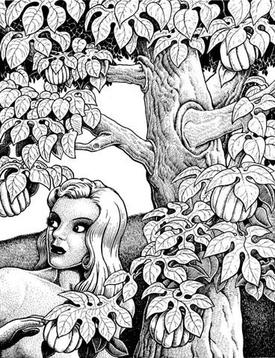
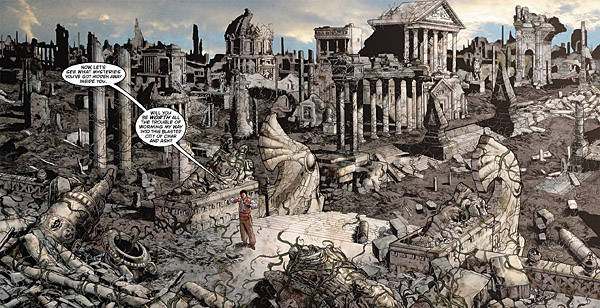
BOOK REVIEW: THE WOLVERTON BIBLE by BASIL WOLVERTON (FANTAGRAPHICS BOOKS, 2012)

It would be easy to give this book a superficial review which concentrated on the more fantastic and grotesque elements which are, admittedly, a large part of the attraction but that would be to do the book and its creator (such an ironic word to use in this context) an injustice. So to be fair, I'm going to explore what exactly the Bible is, its relationship to Wolverton himself and also to me, an atheist of over 40 years standing.

The Bible, specifically the Old Testament which is what I'm almost solely referring to for this review, is one of the oldest sources of history. It's a compilation of creation myths, religious and moral teaching, and the story of small Middle-Eastern monotheistic tribe's struggle to survive to become a nation and to define its identity. That said, as a source of history it is often unreliable simply because it has been written and rewritten many times in order to present a more cohesive picture but it's the overall picture which is interesting. It ends, if memory serves me correctly, more or less with the Maccabean revellion against the Romans and the beginning of the dispersal of the Jews.

This dispersal or Diaspora had the ironic effect of forcing the Jews to become self-sufficient and maintain their identity wherever they went rather than being absorbed into local populations. Ironically two thousand years later when a mad dictator tried to kill them all off it ended up with the Jews regaining what they had long considered their homeland, the very opposite of what old Adolf H intended. Shame he never saw it happen. But that which did not kill them made them stronger, to paraphrase one of his heroes.

Had it not been for the birth of Yeshua bar-Joseph -Jesus being, of course, the Greek form of the name- and the resulting New Testament, the OT would probably have ended up being a minor curiosity studied only by academics. Instead it, along with the NT,  became the most widely read book in history, with the possible exception of Mao Tse Tung's Little Red Book, and had a major impact on the development of civilisation, most notably in the 'West'.

Essentially Christian culture suffuses Western thought and Biblical imagery once dominated its art. I was a child in the 1950's and attended a Methodist Sunday school until around the age of 14 when I first began to question what I was being taught. For the next several years, during which time I took Religious Education at A-level and then Religion as my main academic subject at a teacher training college, I fought a battle within myself over the contrast and conflict between faith and science. By my mid-twenties the battle was over and atheism had prevailed. So, here I stand, an atheist but one who is nevertheless steeped in Christian/Biblical culture.

Basil Wolverton went the other way, more or less, becoming an atheist in his teenage years but a Christian two decades later after correspondence and meetings with Herbert Armstrong the radio evangelist and leader of the (heretical by mainstream Christian views) sect the Worldwide Church of God. (Side note: his son Garner Ted Armstrong was well known to -and a figure of fun to teenage- listeners of Radio Luxembourg in the 1960s.) Less restrictive than many fundamentalist sects, the WCG had a definite appeal for the charming, easy-going sociable (according to many sources, notably his son) figure of Basil who liked a drink, to party, and to go hunting and fishing.

Wolverton began his series of illustrations to accompany text in the Church's magazine and there's little doubt that he regarded it as his most important work -full details are in the book. He avoided the New Testament because the sect (i.e. Armstrong) believed it was wrong to depict his saviour, though that didn't prevent him from having a go at the Revelations of St.John the Divine which is in itself the most misunderstood book in the Bible, most notably by fundamentalists who often display a shocking lack of background knowledge of their own faith. Still, what can you expect from people who are so stupid that they believe the Bible (with all its internal inconsistencies) is the divinely inspired word of God. Maybe He's just got a short attention span. Revelation allowed Wolverton indulge his wonderful fertile imagination and sense of the grotesque and, yes, to a secular reader this is the most impressive and vibrant part of the book.

But that isn't to dismiss what came before. The Old Testament is packed with stories and characters that have become archetypes and images which have become icons. Wolverton also gives us the I Am A Jealous God figure of the OT. His imagery is dark and powerful, bleak and often grim. A small amount of text summarises each section of the Bible he illustrates.

Graphically this is a hugely impressive work, whether you appreciate it purely on an aesthetic level or with an awareness that here lies some of the roots of our culture. This is really quite a unique and very special book and is well worth your time and money.

I doubt very much, however, (and here I breathe a sigh of relief) if it will convert anyone to the Worldwide Church of God.


Sunday, 16 December 2012

GRAPHIC NOVEL REVIEW: FAIREST vol.1 WIDE AWAKE (2012)


Previously published on Amazon as a 5* review.

This Fables spin-off is not only the best of Fables spin-offs, it's actually better than Fables itself. The idea behind it is to tell background stories of the women of the Fables universe with tales of varying lengths. In this first volume we have a 6-parter and single issue story.

Wide Awake, the main story is an origin (the real one) of Sleeping Beauty aka Briar Rose and it's ingeniously done. Set after the fall of the Adversary in the main continuity, Ali Baba the self-acclaimed Prince of Thieves, frees an effrit, not a djinn as he hoped, who can only offer him knowledge rather than three wishes. The effrit, a highly intelligent and sophisticated imp, for reasons of his own encourages Ali to steal Sleeping Beauty's slumbering body from goblins who've captured her only to find that there are two sleeping women, both of whom he awakens. Unluckily for Ali, one of them is the Snow Queen, former right-hand woman for the Adversary, who has a penchant for listening to stories and she finds that of SB's most interesting.

What we have have here is, written by Fables mastermind Bill Willingham who is at the very top of his form, a delightful story itself, packed with wit, invention, action, and romance which expands on the background to the Fables stories. 

The art by Phil Jiminez is to die for. He's emerged from his George Perez lookalike phase as a sophisticated artist in his own right. His men are handsome, his women gorgeous, his monsters and villains hideous. And I must add a note of appreciation for the rich and subtle colouring of Andrew Dalhouse which does so much to enhance the art. It's a disgrace his name isn't on the cover.

 
Set in the 1940's, the single-issue story is sepia coloured noir written by Matthew Sturges and illustrated by Shawn McManus. In it, a heavy-smoking Beast playing a hard-boiled private eye is hunting the Lamia, a serial-killing Fable, who has arrived in Lost Angeles. It's neat, nicely done and has a killer twist I wouldn't dream of spoiling.

If the creators of this title can maintain the standard set here, then us lucky readers are in for a feast of delights in the near future.

Friday, 14 December 2012

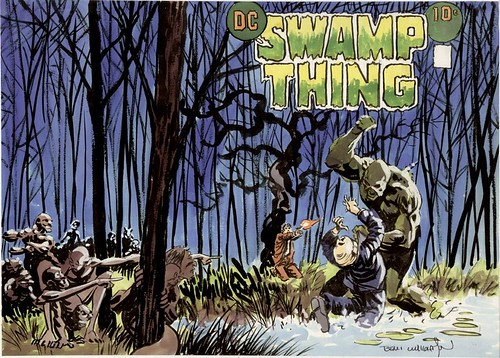
GRAPHIC NOVEL REVIEW: ROOTS OF THE SWAMP THING (DC COMICS CLASSIC LIBRARY)

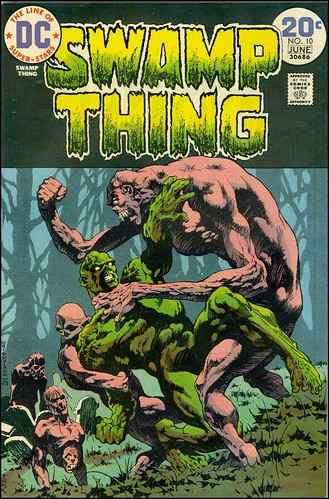
This had been out for nearly a year before I even realised it existed and even then I couldn't get it from Amazon and had to pay more for a copy on Ebay. But it was worth it. This is the collection of one of the two comics which got me back into reading comics again almost exactly forty years ago -the other being Roy Thomas & Barry Smith's Conan (which I also have in hardback). That's 1972 for the numerically challenged. The book contains all 13 issues of Swamp Thing that were written by Lein Wein, the 10 illustrated by Bernie Wrightson, 3 drawn by Nestor Redondo and the precursor to the series, an 8 page story from House of Secrets which created a big stir. All in a nice solid hardback with decent paper.

The very first words on the opening page of Swamp Thing:1 are: Beginning --a NEW kind of graphic excitement-- The SAGA  of the SWAMP THING! And for once, rather than being outrageous hyperbole, this was the simple, plain unadorned truth.

Well, more or less.

Muck monsters weren't anything new -back in the 40's there was The Heap- they'd just never been fashionable before. The Heap was also brought back later that decade when Eclipse Comics revived, and to great success (trans. I loved it) Airboy and his friends.


But what made Swamp Thing the great success was the art by Bernie Wrightson who came over as a cross between EC artists Berni Krigstein and Wally Wood with his eye for the grotesque, his distinctive style and very fine lines. The script by Wein was good for the period but not noticeably outstanding. His plots were better as we got: a brilliant young scientist trapped in a grotesque body which could form words only with the greatest difficulty who comes into conflict with diabolist Arcane (who later played a major villain in Alan Moore's revival) and his Un-men (who got their own Vertigo series), a Frankenstein's monster-like creature, a wolfman, witches, robots with a twist, a Lovecraftian monster, an alien, and Batman. The actual stories were better than the dialogue and suited the maturing young Wrightson to a T.


Back then, no-one had seen art like this in mainstream comics before. It was grotesque, it was scary, it was beautiful. It was, by the standards of the time, breathtaking and a world away from the clean bright conventional superheroes. Swamp Thing inhabited the places they never even thought to go.

It was the best comic of its day and forty years later it still stands up. This is a collection that no comic lover should be without.

Post script.

Nestor Redondo, who replaced Wrightson, was by no means a weak substitute but a very talented Philippino comics artist. If he lacked Wrightson's eye for the grotesque, he made up for it with an attractive, clean and detailed style. He died in 1995.


Bernie Wrightson, however, is still with us and still active. He's currently working on stories about a revived Frankenstein's creature with writer Steve Niles and I'm impatient for the trade paperback edition..

Saturday, 8 December 2012

BOOKS: BOOKS WAITING TO BE READ

And these are only the most recent titles.

(NB: this is a book created to accompany a 2004 exhibition of Tezuka's work at the National Gallery of Victoria in Australia. Quite scarce, I picked it up for a reasonable price on Ebay because no-one else put in a bid.)

(A long time fan of this series, I only just found out that this and some others I'd missed were available.)

(Following his recent death,the insults by cretins commenting in some of the tabloids because he never gave up on Marxism were just appalling and made me want to seek out his books.)
(The only book on sport that I have ever bought or will buy.)
And if I was to include all the books sitting on my shelves waiting to be read, this list would more than double in length.


Wednesday, 5 December 2012

BOOK REVIEW: SPACEHAWK by BASIL WOLVERTON (Fantagraphics Books, 2012)


Writer/artist Basil Wolverton is one of comics cult legends. He produced some weird and wonderful science fiction stories in the early 40's; in the 50's he became a legend for his physical and surreal grotesqueries which appeared in Mad Magazine; and later in his life, following his fundamentalist evangelical faith, he focused on Biblical and apocalyptic images.

Spacehawk is one of his earliest works and this is a complete and chronological collection of the (usually) 10 page stories which appeared in Target Comics. The first  nine stories are set in the future where our hero zips and zaps around the solar system defeating evil (often with extreme brutality and usually with lethal force) which he senses mentally. His powers are vague but do include super-intelligence, able to transfer a humanoid brain into a dinosauroid creature or knock up a robot fish in half an hour. He's very strong but not quite invulnerable, and has various mental powers. He's also at least over 800 years old.

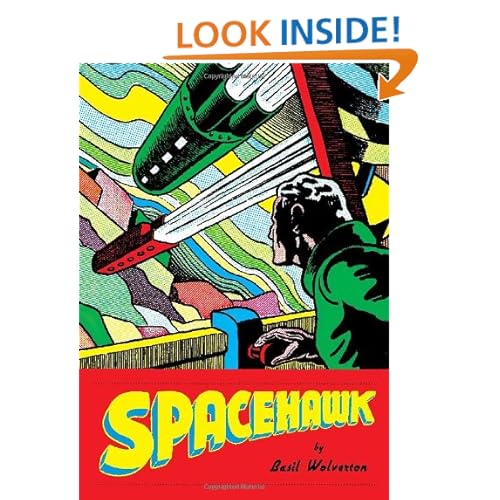
This was his only cover appearance.

The creatures, aliens, and humanoids in these stories were strange and often quite wonderful, such as the bad guys whose neck and head bear a strong resemblance to a penis but obviously no-one noticed at the time. Please let me know if I'm seeing something that isn't there.

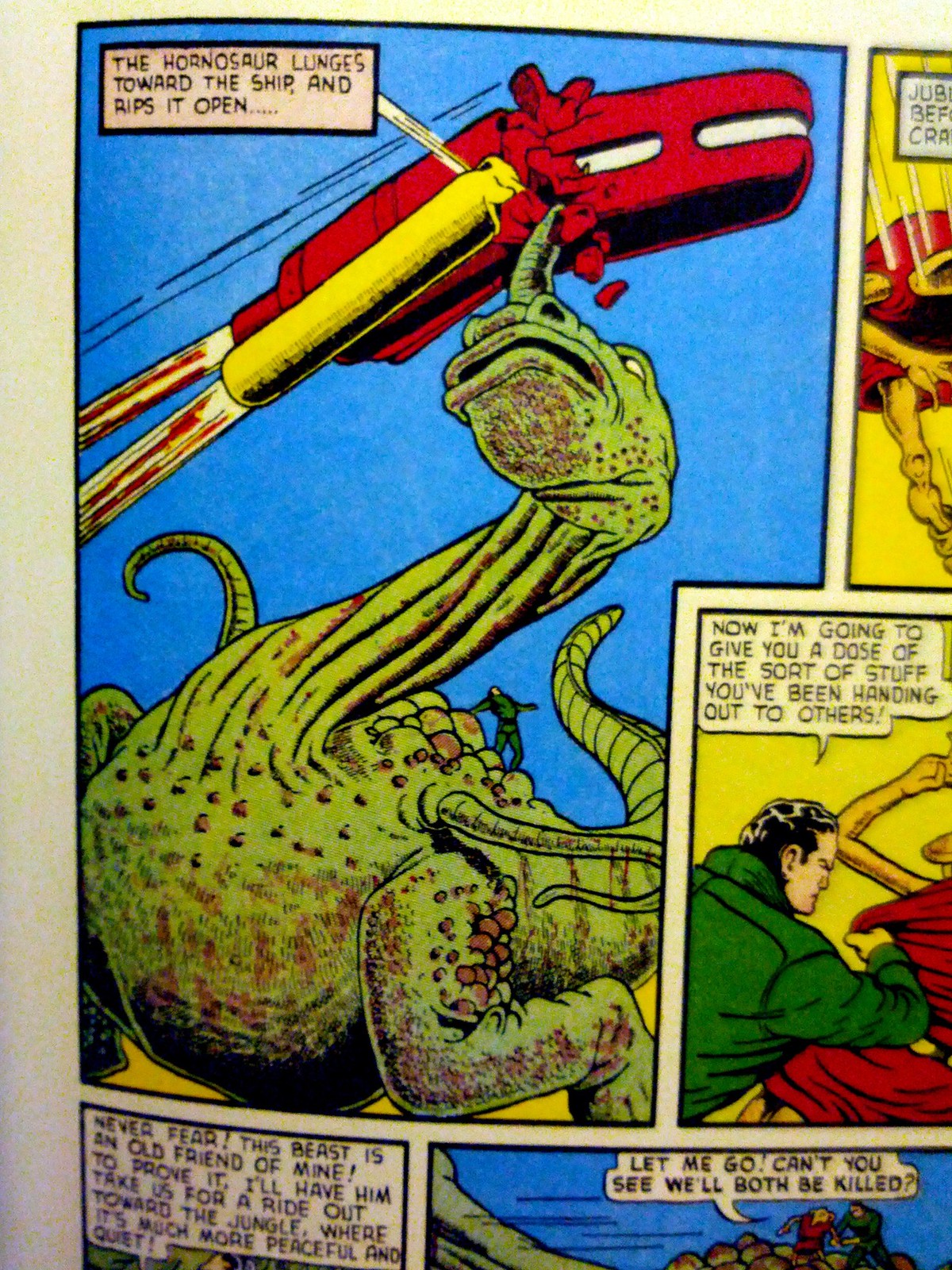
And then, very abruptly, Spacehawk was suddenly contemporary with his readers, the smell of war was in the air with World War 2 already well under way in Europe. Now he fought thinly disguised, and then not thinly at all, the Axis powers which allowed Wolverton to caricature Germans, Italians and Japanese, something he did with great gusto. But you'll have to take my word for it as the image below was the only one I could find. After 20 stories in this vein, Spacehawk was cancelled, never to be revived.


Fantagraphics have done a great job in the presentation. The book is large size, larger than the original comics, on good quality paper (which has a nice smell to it), and there's an informative introduction by Wolverton's son who also followed in his father's footsteps.

Even better from my point of view, I originally ordered this title when it was £13.99, used an Amazon voucher to knock a tenner of it, and when it was finally published clocked in at £18.99. Sweet.

Sunday, 25 November 2012

MUSIC, BOOKS, DVD: RECENT AMAZON REVIEWS

Been a while since the last post. Several reasons: I've been busy; I haven't been well; I'm splitting up from my wife; I'm in the process of buying a house; I couldn't get in the mood. I'm forcing myself to do this one even though it's easy as it's mostly already written. I did have plans for: an overview of the two DVDs and the official book of the London 2012 Olympics; a run through of books I've read, am reading, and am waiting to read; ditto for DVDs.


Why do I keep buying Grateful Dead albums?

 I'm certainly not a Deadhead; a Deadhead being the accepted name for die-hard fans of the band and who, if they can afford, buy every single (an inappropriate word given that most of their releases are multi-volume live sets) thing issued. I most certainly do not. I doubt if I own more than a quarter of their live output. True, I also have the two massive box sets of their official major label releases (with lots of extra tracks) but that doesn't make me a Deadhead. I most certainly have not nor have I any intention of buying any of the massive live sets (like the complete Europe 72 concerts or the one from which this collection is culled). But equally I can't deny that I'm a big fan and they are my favourite band.

I'd like to propose another class of GD fan called: (and ripping of shamelessly from Sam Raimi's The Evil Dead -I'm also a horror movie buff) The Deadite. The Deadite is an enthusiastic GD fan but not obsessively so. They're someone like, well, me who had to have this compilation but not the massive set from which it's compiled.

And, boy, am I glad I did. Clocking it at around 79 minutes on each of the two discs, you couldn't possibly get more for your money, and a reasonable price it is too. Later period Dead isn't as fashionable as their 70's heydays but this set goes some way to correcting the image of later period as somehow inferior. Let me tell, om these discs, the band are on fire. They are as tight and as sharp as I've ever heard them. Maybe it's the production or better quality drugs, I don't know. What I do know is that, because it's a well chosen compilation, there isn't a dud track here. You could even use it as a introduction to someone who's never heard the Dead before.

No question, this is one of their best live releases ever. 

 First off, I write this as a long time reader of SF and Fantasy novels, and of super-hero comics/graphic novels/whatever, and comics in general and review all of them regularly, often here on Amazon. Turning my head from the screen I can look at my bookshelves filled with dozens of super-hero graphic novels. Okay, credentials established, herewith the point of this review. Super-heroes don't work as prose fiction. Qualification: I'm talking about the costumed super-heroes who live in a common universe of the like of those established by DC and Marvel. You can have what are effectively non-costumed super-heroes disguised as, say magic users and it will work -see my recent review of Hard Magic- but mainstream costumed super-heroics don't.

They can, just about and albeit watered down, work on TV (Smallville and the recent Arrow), and work very well on film but even there it helps a lot if the director is Joss Whedon. But where they work perfectly is the place that they came from -comics. In comics the stylised dynamic art creates a convincing hyper-reality that transcends the essential silliness of the concept. Comics were made for super-heroes and it's their natural home.

But prose without pictures isn't. I've read a number of novels which attempt to transcribe costumed super-heroes from their home into another format and, with one glorious exception, they don't work. And Seven Wonders isn't the exception.

I can't go into too much detail because I'm assuming a few of you will be buying this book so I'll have to comment in more general terms as I don't want to write any form of spoilers. In the Californian city of San Ventura lives the world's last super-villain -The Cowl- and his nemeses, the superhero team known as Seven Wonders -probably because the wonder is why they can never catch him. The our hero suddenly discovers he's developing super-powers and battles the Cowl who attempts to rob a bank where he's cuing up for cash and defeats him. What follows is a multi-viewpoint story in which, if you can't guess most of the surprises, twists and turns, you haven't been reading comics (or any fiction) lately.

And what also follows is why the book doesn't work. The author hasn't attempted to create a prose form which describes super-hero battles, and other super-hero tropes, that actually works. "Avengers assemble!" works fine as a battle cry in a comic in big dynamic lettering and shouted out by Captain America but is just silly in text- "Seven Wonders, unite!" when spoken by a character we know little about. The descriptions of super-hero fights are ploddingly mundane without any accompanying images. But to be honest, the rest of the prose is competent at best and the real story, when we finally get to it, just isn't very interesting.

In short:it just doesn't work.

To be fair there are three pages of ringing endorsements from numerous people whose names I recognise and all of them are in the comics industry, most of them being comics writers, so I suppose they would say that, wouldn't they?

And the one glorious exception to super-heroes in prose -it's the Wild Cards series, a shared world created by George R R Martin (Games of Thrones) a few years ago with the help of many other talented writers. Try and get the original series but avoid a more recent attempt to revive it. 

(NB. Since writing the last half of the final sentence I've discovered there have been three more Wild Cards titles since the unnamed two which didn't impress me and I've ordered all three.)


 Promising start to a tough alternate magical mystery history series.

Despite the cover, it isn't hard-boiled fantasy but good secret society vs bad secret society. It's also more of an ensemble character piece with frequent shifts of viewpoint between the various characters. Despite the emphasis being on magic -it exists and an individual can (supposedly) only have one magical power- it reads to me more like secret societies of superheroes.

Whatever. Basically history has been changed by the existence of people with magical/super powers and public reaction has varied. But that's just the background. The story is the recruitment of (really, really, really) tough guy Jake Sullivan to the cause of the good guys magical secret society and their hidden war with the bad guys magical secret society. It's about 20% too long but it still kept me reading and I'll be back for the sequel. 

Pleasantly surprised.

While not without its flaws, this is actually quite a good reworking of the old Edgar Rice Burroughs novel of A Princess Of Mars, providing a semi-rational explanation of how Carter gets to Mars in the first place -which is more than old ERB did.

On the acting side is solid work from hero Taylor Kitsch who is outshone by a feisty Lynn Collins as Dejah Thoris, with solid support from the supporting cast including Dominic West, Ciaran Hinds, and Mark Strong. The special effects are convincing, especially the four-armed Tharks led by Tars Tarkas (Willem Dafoe). The airships are good to look at and it usually moves along at a fair pace.

I can't understand the downpour of heavy criticism the film engendered as it's a solid and entertaining genre piece. Sadly this means there won't be any sequels or other movies set in exotic alien landscapes with two-fisted lantern-jawed blaster-wielding heroes, beautiful mysterious heroines and ancient and deadly secrets from the heady days of Pulp SF and written (at its best) by Leigh Brackett. Alas.

A likeable subtitled Spanish horror-comedy.

This is a low budget pleasant time-passer in which the humour comes out of the characters rather than being forced, which is always a good thing. To save money, rather than film the prologue which sets the scene, we get an illustrated one which resembles racy comic book art and is quite effective.

Once that's over, the film itself is set in and around an isolated and cursed Spanish village. Removing the curse (a wolfman) depends on our hero getting eaten on a specific day by the wolfman and if he isn't a worse curse descends on the village. Needless to say, this happens and the English title sort of gives away any surprise as to its nature. The gore is moderate and often undercut by humour. The monster is quite good and accurately depicted on the 3-D cover and a very effective 3-D cover at that.

Approach it with moderate expectations and a couple of beers and you'll have a reasonably good time. 

 I have mixed feelings about this book as there is a lot to like about it but I also have one major gripe.

The good stuff includes an interesting premise which sets this apart from other Urban Fantasy (of which I've been reading a lot lately) as three mismatched coppers (police to our overseas friends) and a researcher are forced together to use police procedures to investigate a crime involving the supernatural. It's more complicated than that but I do try to avoid spoilers. It also involves a major football club (West Ham) and Anne Boleyn, and a really vile villain who commits certain acts which are truly shocking and horrifying to even the most hardened reader. It builds well to a climax and sets the scene for a sequel.

Cornell is a competent writer of growing experience but one who lacks a talent able to deliver the groin-gripping prose of, say, the current maestra Kate Griffin.

My gripe is that the characters are never vivid or distinctive enough, particularly in the beginning and it took me a while to get any sort of handle on them and I never really did with one. Eventually the sheer power of the story does overcome this and it kept me reading right to the end but it's still a misjudgment on my part. Or maybe it's just me.

Worth reading at a rating of three and half stars for fans of the genre but be prepared to persevere at first. 

Post Script.

There's another couple of CDs I'd like to have reviewed but I haven't listened to them enough to do them justice (though I know I like them a lot). They are: Emeli Sande's Our Version of Events (special edition) and Neil Young's Psychedelic Pill and you can't get much more diverse than that. The Young ( with Crazy Horse) CD begins with a 27 minute long track which is longer than some famous artists entire albums.