Showing posts with label 75 years of DC Comics. Show all posts

Friday, 18 November 2011

GRAPHIC NOVEL REVIEW: KAMANDI THE LAST BOY ON EARTH by JACK KIRBY (DC, 2011)


I confess I’m not a great Jack Kirby fan. I understand and appreciate his historical importance to the super hero genre but I’ve found his storytelling to be both simplistic and overblown while admiring, on an aesthetic level at least, the vigour of his art.

After basically creating Marvel Comics with Stan Lee (okay, Steve Ditko and Gene Colan may have helped somewhat), he moved to DC at the beginning of the 70’s where he was pretty much given free rein to create his own line of comics. And what he did was create Kirby’s Fourth World which include the god-like villain Darkseid. If you think that name is bad, there’s always the hero Scott Free aka Mr Miracle, and others whose name are too painfully awful to mention. My objection to Darkseid is that he’s so powerful I could never be convinced by his being defeated by DC’s superheroes, not even Superman. DC have been mining Kirby’s legacy ever since and even Grant Morrison couldn’t convince me that Darkseid was a good character. His New Gods have also made some impact on the DC universe, Forever People less so.

Thankfully that wasn’t Kirby’s only legacy to DC. OMAC continues to make an impact and is currently revived by DC as part of the reinvention of the DC universe. As is  Etrigan the Demon whom Alan Moore brought to vigorous life during his run on Swamp Thing, thereby sealing the character’s position in the DC universe. Mind you, Kirby’s original version was pretty good too. And also pretty good was Kamandi The Last Boy On Earth.

It’s a cheap and cheerful intentional rip off of Planet of the Apes.   Kamandi has emerged from Command D, a government shelter where, presumably, generations of humans have lived since a nuclear war, only to find that humans are effectively animals and used as slaves by the variety of tribes of intelligent bipedal animals (lions, tigers, gorillas, etc) who live among the remains of what was, and unrecognised by them, human society. Kirby’s art is at its vigorous best and ably inked by Kirby’s own choice Mike Royer (who provides an introduction) for 20 issues included in this volume, plus a further 13 of the final 20 that Kirby would draw which we’ll hopeful see in a companion to this book next year.

Kamandi is a curious choice for a hero as he’s incredibly arrogant and super confident, convinced that he’s superior to the various animals who believe him to be inferior (like the rest of the humans). It may be a sly joke on the part of the Jewish Kirby to create such a blonde Aryan hero who is a conceited pain in the backside. His story is that of a journey of discovery as he explores this strange new world, having adventures, making friends and enemies and even, briefly, a girlfriend who can talk. There’s also Tiny a nifty version of King Kong who can talk and wants Kamandi as a pet –no, there isn’t a gay subtext- and suffers, you won’t be surprised, the same fate as the original. The animal tribes themselves, by their behaviour, are parodies of human society and there is some social comment here but I wouldn’t pay too much attention to that as Kirby is just here to have fun.

You will too.

At £37.99, Titan publishers’ edition (actually the US edition with a bar code sticker on the back cover) is a bit expensive even for 450 pages of prime Kirby. Amazon’s current price, however, is a much more appealing £22.99. The paper quality is similar to that of the original comic which is fine as that’s what the art and the colouring were designed for and it would look odd on anything else.

Post Script.

In the post from Amazon, another graphic novel by Osamu Tezuka –The Book of Human Insects which was created, I believe, around the same time as Kamandi.

Tuesday, 19 July 2011

BOOKS: GRANT MORRISON SUPERGODS

The author in his younger days and as he is now-
Doesn't he look so cool?
And here's the crap cover of the English edition of his book.
Morrison is generally considered to be one of the great British writers of American comics who is either on, or just slightly below, the same pantheon which includes Alan Moore and Neil Gaiman and his other peers are Warren Ellis and Mark Millar. If none of those names mean anything to you, then this isn't the blog for you. I'm inclined to rank them in the order I've listed with Morrison at No.3.

This book is basically his love affair with super-hero comics, their effect on his life, and his effect (as a writer) on them. I've read a couple of British press reviews of the book and both reviewers miss the point. They like it fine when he's doing a history (albeit a narrow and stylish history) but feel it goes off the rails when it becomes a personal story. They have, of course, got it wrong. The historical account is simply the context for Morrison's personal exploration of the super-hero genre and when it gets personal, it gets going. This isn't a history of super-heroes, though his account of the genre and his response to developments in it is vital to understand how Morrison sees how it should be transformed.

Of particular interest are his reactions to Moore and Gibbons transformative Watchmen. Morrison admires the technique, skill and intelligence which goes into it but finds it a hollow exercise -I'm simplifying here, read the book for his full argument- and made this clear at the time. Several years later Moore described Morrison's Arkham Asylum (with artist Dave McKean) as 'a gilded turd'; 'gilded' referring to the art, 'turd' to the writing. Morrison's opinions on the work of his peers are elegantly expressed and endlessly interesting.

Where the book becomes truly fascinating is when Morrison delves into his experiences with drugs and mysticism which alters his entire perception of the world.

Or:

Where the book goes completely off the rails and Morrison is exposed as a self-obsessed nut-job is when he delves into his experiences with drugs and mysticism which alters his entire perception of the world.

Depending on your own inclination. My own view of the world, as a libertarian-leftie atheist who has faith only in hard science and a deep distrust of any form of mysticism, is to take the second view. And yet the more you read of these experiences, the more strangely convincing they become. Morrison sees an analogy between inserting himself into two dimensional fiction space -as he does when he confronts the protagonist of the comic he's been writing (Animal Man)- and dimensions higher than ours which we, like Animal Man himself, are unable to perceive. (To get the next reference you need to read the book for its context) Flash Fact: five year old children cannot see perspective but seven year olds can.

I find this whole personal journey quite fascinating for how it informs the super-hero comics he's written and into which he goes into considerable detail which is all interesting as he's written some of the best mainstream superhero comics ever as well as some of the best oddball comics.

And here are some of them-
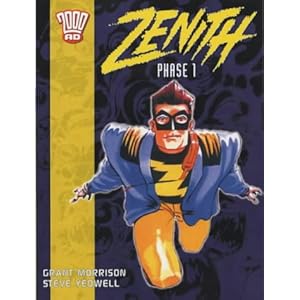
Starting with The Invisibles. Spot the Morrison look-alike.

This actually needs a little explanation. Batman here is Dick Grayson (formerly Robin, formerly Nightwing), and Robin is Damian al-Gul (son of Talia -herself the daughter of Batman villain R'as al-Gul- and Bruce Wayne) and he's a bit of a psycho.

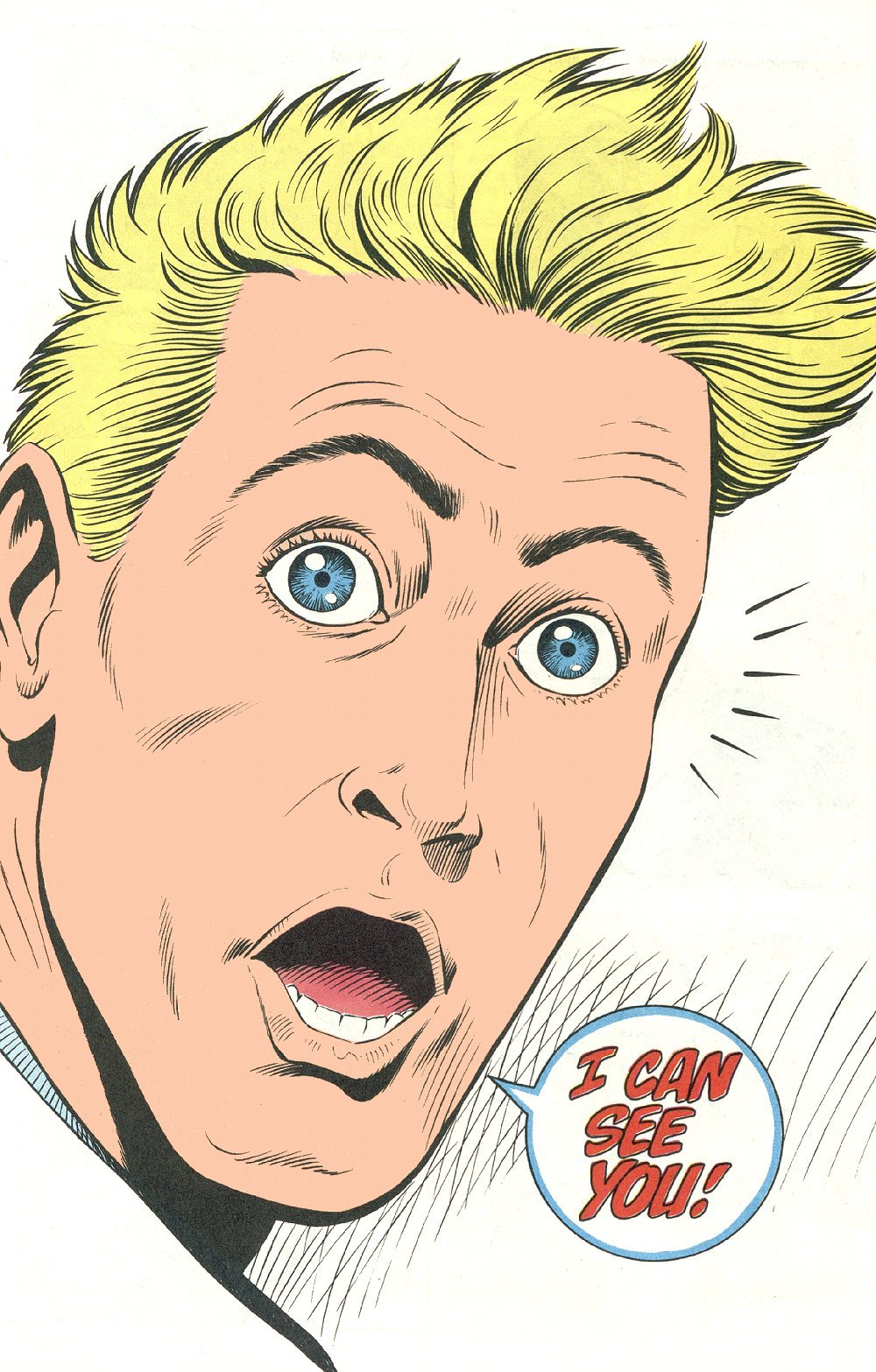
And this is the panel from Animal Man where our hero looks beyond the borders of the panel (breaking what is known in trade a 'breaking the fourth wall') and sees the people looking at him. If you can believe Grant Morrison, he can see you too.

Saturday, 27 November 2010

An Amazon 5-star review.

Get yourself fit the DC way.

Simply buy a copy of this book but don't remove it from its case. Now, with the book flat on the ground, slide your hands underneath until the full width of the book is flat against your arms. Now lift until the book is on a level with your chest and hold the position until your arms feel as if they're about to drop off -trust me, it won't take long. Repeat until you realise there is a much better use for this book, open the case, now enjoy the wonderful contents.

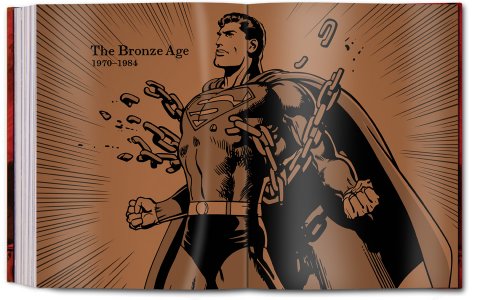
There has never been a book like this about the comics industry and probably won't be again, at least not for a long time (unless Marvel, not untypically, follow DC). It is huge -not a coffee table book, a dinner-table-for-eight book- and extremely heavy. Whatever you do, don't drop it on your foot or you could easily break a toe. This is not a joke as the size and weight of it makes it impossible to hold on your lap. The production values (publisher Taschen is known for this) and the contents are magnificent. It is, obviously, an authorised (and no doubt sanitised) history of DC comics but that's fair enough. Although the copious and beautifully reprinted illustrations almost swamp the text, a reviewer at Amazon.com reckoned the word count to be around 100,000 (a conservative estimate?) so there is plenty of text to read.

Although expensive, and the most expensive book I've ever bought, it's worth every penny to anyone interested in DC Comics or the history of comics in general. I've read that some people consider this to be an investment as it's bound to be a collector's item once it goes out of print; which is something I've considered. If you're thinking of buying it for that alone, here's a word of warning. It is almost impossible to open the case the first time without damaging it slightly and the case is also easy to scuff. Bearing that in mind, I suggest ordering two copies, one to enjoy and the other to keep in pristine condition. (Sorry, this is what's called winding up the opportunists).

Gorgous book. I love it. Comics-related book of the Decade, no question.