Showing posts with label graphic novel reviews. Show all posts

Friday, 11 October 2013

GRAPHIC NOVEL REVIEWS: BATWOMAN VOL.3, JUSTICE LEAGUE VOL.3, SHAZAM VOL.1, WONDER WOMAN VOL.3 (DC, 2013)

It's been a couple of years now since DC revitalised, to mixed success and with mixed results, its superhero continuity by starting afresh. Some titles (mostly the several featuring Batman) continued more or less unchanged with their individual continuity now compressed to fit into five years (a period before the new titles began). Some characters disappeared like the Stephanie Brown incarnation of Batgirl and Barbara Gordon (now recovered from being crippled by the Joker) back in the role.

The Justice League is back with its core heroes -Batman, Superman, Aquaman, The Flash, Green Lantern, Wonder Woman -and Cyborg who was now never in the Teen Titans (it seems). Written by Geoff Johns and now with dynamic detailed art by Ivan Reis (replacing superstar Jim Lee) it continues to be a highly entertaining action-packed superhero title. This collection has two storylines: the League versus a newly empowered Cheetah (the old Wonder Woman villainess) and the League vs Atlantis in a crossover with Aquaman. It's a lot of fun.


And she has an unfortunate effect on Superman.

Batwoman, who only appeared not long before the new continuity, is more or less unchanged and is the most artistically successful being co-written (by the character's co-creator) and illustrated by the same, genius artist JH Williams III. This, however, is about to change as he quite after DC management refused to let Batwoman marry her girlfriend. It wasn't personal but policy as none of the characters are allowed to be married.

This collection is mostly a team-up with Wonder Woman, who's appearing a lot in this post, and it's probably the weakest installment so far. Which isn't to say it's bad by any means, it just isn't quite up to the high standard already set.


In Wonder Woman there's a lot of focus on the Greek Gods, an important part of her continuity but not one I've ever cared for. However, writer Brian Azzarello with artist Cliff Chiang has scrapped the old ancient Greece look and made them move with the times. No more armour and flowing hair (the men), but jeans, open necked shirts, and Jack Daniels.

This volume continues the ongoing story of Diana (WW) trying to save the life of a baby (one of like, WW herself, Zeus's children spawned on a human) who is under threat, along with the mother, from jealous wife Hera. There's a lot more to it than that but I can't be arsed to go there. Despite the sketchy art which I'm not keen on, it's a good refreshing take on the character.

And there's an appearance by super tough guy Orion of the New Gods who gets his arse handed to him by Diana.

But this is the title I really wanted to write about.


This character has a long but not complicated history. 

For a start, he wasn't called Shazam but Captain Marvel. Co-created by artist CC Beck for Fawcett Comics, he appeared not long after Superman and became very popular until, some years later, DC sued Fawcett by claiming he was a copy of Superman. This was patently ridiculous but DC still won, Fawcett collapsed and DC took over ownership of the character.

By the time they decided to use him, Marvel had already copyrighted the name Captain Marvel so DC were not allowed to use that name on the cover of any comic featuring the character though the character kept that name. Shazam! is the magic word he used to transform himself from the adolescent Billy Batson into the world's mightiest mortal.

Note the word magic in there. This was already one significant difference between him and Superman. Neither did he have Superman's range of powers. Cap was basically incredibly strong, invulnerable, clever, very fast, and could fly. Basically, like the man of steel himself, Cap was what became accepted as one of an archetype -the super-man. 

Also different from Superman, his adventures were more naive, cartoony in visual style, and full of charming absurdities like Tawky Tawny the intelligent tiger. He also had a super 'family' who shared his powers to a lesser degree and included Captain Marvel Jnr aka the crippled kid Freddy Freeman, Mary Marvel, and the non-powered Uncle Dudley Marvel.

Heading towards the millennium, DC took the character more seriously as they integrated him into their own continuity -for years he was in a parallel world until the Crisis On Infinite Earths got rid of the multiverse.

Now writer Geoff Johns has recreated the character for DC's revised continuity and he has done a very clever and interesting job of it in collaboration with the excellent artist Gary Frank. Somehow Johns has managed to keep much of the mythos of the character while updating it for a modern audience. A lot has changed since 1939. You can see him above. Below is what he used to look like.


Okay. Alter ego Billy Batson is no longer a naive kid who wants to do good but a 15 year old who's been in care and foster homes all his life and has become cynical, manipulative, and out for himself though, under the right circumstances, he can do the right thing. His name is now Shazam after his magic word which was given to him by a wizard (this origin remains virtually unchanged) who looks a bit like a grizzled Australian aborigine rather than the long white haired white man.

He's taken in by a decent couple who already have several foster children who he wants nothing to do with. Needless to say, this changes. On getting his powers he uses them to get money for food and beer and also, almost inadvertently do some good deeds.

Also reborn is his nemesis Black Adam who goes looking for Shazam to extremely violent effect.

I'll skip the details as I don't want to spoil it for you. The content of this graphic novel originally appeared as as a series of short in the back of the Justice League comic but they don't read like that. What you get is a full blown origin story that touches all the bases, while updating it in an interesting way. Shazam now has his own title and I'm looking forward to the first trade. Meanwhile check out the samples below.


Sunday, 6 January 2013

BOOK REVIEW: THE WOLVERTON BIBLE by BASIL WOLVERTON (FANTAGRAPHICS BOOKS, 2012)

It would be easy to give this book a superficial review which concentrated on the more fantastic and grotesque elements which are, admittedly, a large part of the attraction but that would be to do the book and its creator (such an ironic word to use in this context) an injustice. So to be fair, I'm going to explore what exactly the Bible is, its relationship to Wolverton himself and also to me, an atheist of over 40 years standing.

The Bible, specifically the Old Testament which is what I'm almost solely referring to for this review, is one of the oldest sources of history. It's a compilation of creation myths, religious and moral teaching, and the story of small Middle-Eastern monotheistic tribe's struggle to survive to become a nation and to define its identity. That said, as a source of history it is often unreliable simply because it has been written and rewritten many times in order to present a more cohesive picture but it's the overall picture which is interesting. It ends, if memory serves me correctly, more or less with the Maccabean revellion against the Romans and the beginning of the dispersal of the Jews.

This dispersal or Diaspora had the ironic effect of forcing the Jews to become self-sufficient and maintain their identity wherever they went rather than being absorbed into local populations. Ironically two thousand years later when a mad dictator tried to kill them all off it ended up with the Jews regaining what they had long considered their homeland, the very opposite of what old Adolf H intended. Shame he never saw it happen. But that which did not kill them made them stronger, to paraphrase one of his heroes.

Had it not been for the birth of Yeshua bar-Joseph -Jesus being, of course, the Greek form of the name- and the resulting New Testament, the OT would probably have ended up being a minor curiosity studied only by academics. Instead it, along with the NT,  became the most widely read book in history, with the possible exception of Mao Tse Tung's Little Red Book, and had a major impact on the development of civilisation, most notably in the 'West'.

Essentially Christian culture suffuses Western thought and Biblical imagery once dominated its art. I was a child in the 1950's and attended a Methodist Sunday school until around the age of 14 when I first began to question what I was being taught. For the next several years, during which time I took Religious Education at A-level and then Religion as my main academic subject at a teacher training college, I fought a battle within myself over the contrast and conflict between faith and science. By my mid-twenties the battle was over and atheism had prevailed. So, here I stand, an atheist but one who is nevertheless steeped in Christian/Biblical culture.

Basil Wolverton went the other way, more or less, becoming an atheist in his teenage years but a Christian two decades later after correspondence and meetings with Herbert Armstrong the radio evangelist and leader of the (heretical by mainstream Christian views) sect the Worldwide Church of God. (Side note: his son Garner Ted Armstrong was well known to -and a figure of fun to teenage- listeners of Radio Luxembourg in the 1960s.) Less restrictive than many fundamentalist sects, the WCG had a definite appeal for the charming, easy-going sociable (according to many sources, notably his son) figure of Basil who liked a drink, to party, and to go hunting and fishing.

Wolverton began his series of illustrations to accompany text in the Church's magazine and there's little doubt that he regarded it as his most important work -full details are in the book. He avoided the New Testament because the sect (i.e. Armstrong) believed it was wrong to depict his saviour, though that didn't prevent him from having a go at the Revelations of St.John the Divine which is in itself the most misunderstood book in the Bible, most notably by fundamentalists who often display a shocking lack of background knowledge of their own faith. Still, what can you expect from people who are so stupid that they believe the Bible (with all its internal inconsistencies) is the divinely inspired word of God. Maybe He's just got a short attention span. Revelation allowed Wolverton indulge his wonderful fertile imagination and sense of the grotesque and, yes, to a secular reader this is the most impressive and vibrant part of the book.

But that isn't to dismiss what came before. The Old Testament is packed with stories and characters that have become archetypes and images which have become icons. Wolverton also gives us the I Am A Jealous God figure of the OT. His imagery is dark and powerful, bleak and often grim. A small amount of text summarises each section of the Bible he illustrates.

Graphically this is a hugely impressive work, whether you appreciate it purely on an aesthetic level or with an awareness that here lies some of the roots of our culture. This is really quite a unique and very special book and is well worth your time and money.

I doubt very much, however, (and here I breathe a sigh of relief) if it will convert anyone to the Worldwide Church of God.


Sunday, 16 December 2012

GRAPHIC NOVEL REVIEW: FAIREST vol.1 WIDE AWAKE (2012)


Previously published on Amazon as a 5* review.

This Fables spin-off is not only the best of Fables spin-offs, it's actually better than Fables itself. The idea behind it is to tell background stories of the women of the Fables universe with tales of varying lengths. In this first volume we have a 6-parter and single issue story.

Wide Awake, the main story is an origin (the real one) of Sleeping Beauty aka Briar Rose and it's ingeniously done. Set after the fall of the Adversary in the main continuity, Ali Baba the self-acclaimed Prince of Thieves, frees an effrit, not a djinn as he hoped, who can only offer him knowledge rather than three wishes. The effrit, a highly intelligent and sophisticated imp, for reasons of his own encourages Ali to steal Sleeping Beauty's slumbering body from goblins who've captured her only to find that there are two sleeping women, both of whom he awakens. Unluckily for Ali, one of them is the Snow Queen, former right-hand woman for the Adversary, who has a penchant for listening to stories and she finds that of SB's most interesting.

What we have have here is, written by Fables mastermind Bill Willingham who is at the very top of his form, a delightful story itself, packed with wit, invention, action, and romance which expands on the background to the Fables stories. 

The art by Phil Jiminez is to die for. He's emerged from his George Perez lookalike phase as a sophisticated artist in his own right. His men are handsome, his women gorgeous, his monsters and villains hideous. And I must add a note of appreciation for the rich and subtle colouring of Andrew Dalhouse which does so much to enhance the art. It's a disgrace his name isn't on the cover.

 
Set in the 1940's, the single-issue story is sepia coloured noir written by Matthew Sturges and illustrated by Shawn McManus. In it, a heavy-smoking Beast playing a hard-boiled private eye is hunting the Lamia, a serial-killing Fable, who has arrived in Lost Angeles. It's neat, nicely done and has a killer twist I wouldn't dream of spoiling.

If the creators of this title can maintain the standard set here, then us lucky readers are in for a feast of delights in the near future.

Sunday, 21 October 2012

GRAPHIC NOVEL REVIEW: SAGA by BRIAN K VAUGHAN & FIONA STAPLES (2012)


A masterpiece in the making?

Among others, writer Vaughan was responsible for the lengthy and deservedly highly praised series Y:The Last Man and the shorter and deservedly less praised (though it wasn't bad by any means) Ex Machina. On the basis of this first volume, he's written his finest work so far, if he doesn't fuck it up as he did with Ex Machina and, to a far lesser extent, with the inevitably anti-climatic end to Y.

I got to the end of this book, put it down, and said aloud, "Wow!"

The plot is simple: two mismatched lovers (he's a pacificist vegetarian magic-user, she isn't) from societies at war with each other are on the run (with their newly born baby) from both sides.

But that's the only thing that's simple. She comes from Landfall, a giant planet and he comes from Wreath, Landfall's very large moon. Rather than destroy each other's worlds, both societies take the battle out into the galaxy and hire other races to help fight their enemy. Most of the races seem to have some human-like resemblance but whether or not this is far future and we're seeing a diverse and vastly diverged humanity or just aliens isn't clear. Even the use of some familiar personal names (like Hazel) may be just a means to ease the reader into the story.

The background is potentially very complicated but Vaughan skillfully (greatly aided by the attractive clean-lined quality of Staples' art) and accessibly establishes the scenario and the characters, both lead and supporting. Our two heroes are very engaging and likeable and all the supporting characters are interesting (such as the hired assassin who will kill children for pay but hates paedophiles; he also has a psychic felinoid). There are no captions and all the narrative is conveyed by dialogue except for the occasional comments by a grown up version of the baby which are woven into the panels in which they occur rather than the conventional box and this works really well.

This isn't kids stuff. It if was a DVD it'd be rated 18 for explicit scenes of a sexual nature, frequent use of (bad) language, nudity, and graphic violence. It's also often funny and, just as often, touching.

The potential of this series is enormous and, from the title, we're in for a long run. 

Side note for Science Fiction buffs: this is wide-screen Baroque SF at its best. Resist that come on if you can.


Saturday, 29 September 2012

GRAPHIC NOVEL REVIEWS: MORE DC NEW 52s


Resurrected with a vengeance, a 5* Amazon review.

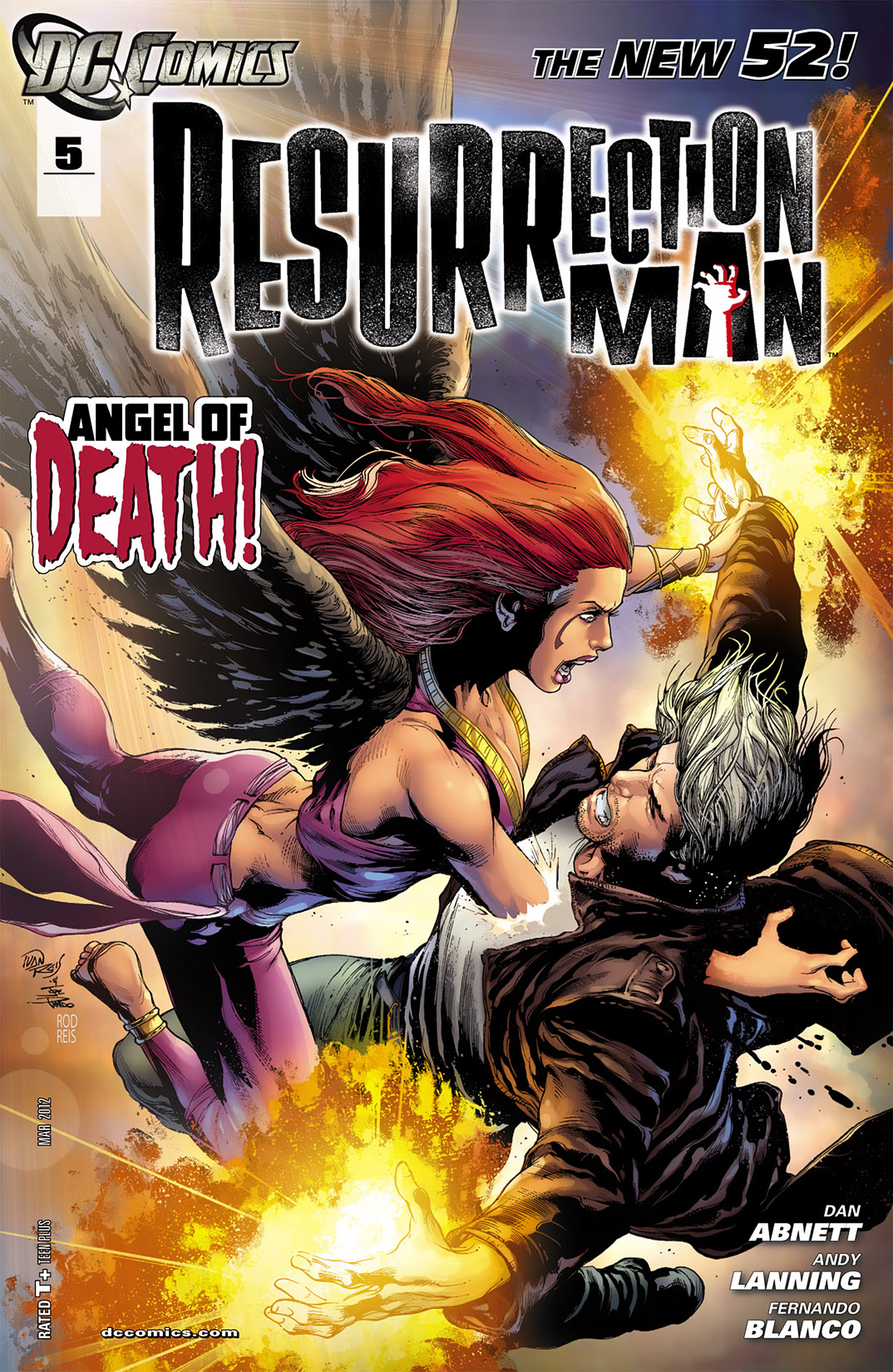
The original run of this title was one of my favourite series of the 90's and now it's back with its original writers Dan Abnett and Andy Lanning so there's no way I was never going to buy this one and I haven't been disappointed.

Unlike some of DC's New 52, it doesn't seem to have squashed the original continuity or some semblance thereof, such as Batman, into the previous five-year pre-publication appearance. No, this is a brand newish Resurrection Man. Our hero Mitch Shelley is pretty much the same person but he has a new and rather unpleasant origin; he appears to have a compulsion to go to particular places where he's needed; Heaven and Hell want him dead and they are both decidely scary. Those loveable sociopathic female hit women Bonnie and Carmen aka The Body Doubles are back but also with a new origin, a teleportation device, and super powers -ouch!

In this seven issue collection we find Mitch fighting a scary angel on a crashing passenger jet, visiting an old people's home, Arkham Asylum, Metropolis, and more. The action never stops, Bonnie and Carmen never give up, the revelations keep coming, and the pace never lets up. This is enhanced by the dynamic detailed artwork of Fernando Dagnino which is just terrific.

How good is this book? I wanted to read it again as soon as I'd finished. That's how good this book is.

(Aside: I've been reviewing a lot of these New 52 titles and my ratings are a comparison of like to like. A 5* rating means it's as good as the best of current DC/Marvel superhero titles. It doesn't mean it's as good as, say, Watchmen or Love & Rockets. Just wanted to make that clear.) 


They aren't kid sidekicks. An Amazon 4* review

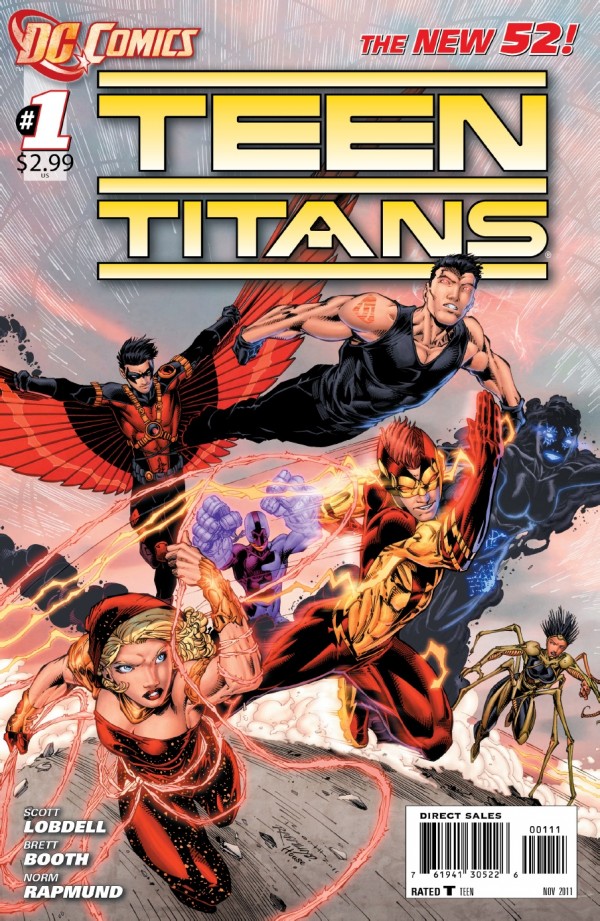
Unlike the TT's of previous incarnations in the old continuity, only Red Robin (Tim Drake) has any direct link to established superheroes. There's also a good idea as to why, in this first volume which is an origin story, these kids get together.

A lot of teen meta-humans have been appearing all over the world and causing a lot of trouble for the authorities. A sinister organisation called NOWHERE (it's an acronym but I'm too lazy to insert the dots) is kidnapping these kids for purposes unknown, but you can bet they aren't good ones. Red Robin has been investigating NOWHERE and blogging about the teenage meta problem. After escape an attempt by them on his life, he tracks down Cassie ("Don't call me Wonder Girl!") Sandsmark just as they attack her. Shortly after following up a lead, he encounters the insectile Skitter. By one of those curious coincidences that only happen in comics, Miguel Jose Barragan (the gay Mexican meta who calls himself Bunker) illegally hops aboard a freight train where he meets a disguised Red Robin with a cocooned Skitter and... And so on.

Amnesiac Kid Flash with a female meta called Solstice (count the number of times her name is misspelled by the letterer), who've escaped from NOWHERE, meet up with the other three and go to the rescue of Cassie ("Don't call...") who is under attack by Superboy.

All in all this is a very promising start to the series. The new characters, technically they're all new, have a lot of potential. The set up is a good one. Writer Scott Lobdell balances action, character beats, humour, and background information all very well so that you can't stop reading because you want to find out what happens next. Brett Booth's art manages to balance an attractive detailed style with just the right hint of cartoon to suggest the original Young Justice. The three letterers need to check their spelling which is a little sloppy at times.

Yet another success for the continuity revamp that is DC's New 52 which is providing the best mainstream superhero stories for years. 


There's nothing fishy about this Aquaman. An Amazon 4* review.

This series is among the most highly praised of DC's New 52 revamps and you aren't going to get any argument about that from me.

We meet an Aquaman in his prime and there are a number of mysteries about his previous life of which only some are revealed or hinted at. He's married to Mera, a mature no-nonsense woman who has less tolerance for fools than her husband, and they live in a lighthouse. Aquaman is a bit of a joke to people who very much underrate him except for those who see him (and Mera) go up against a race of hominid fish with the appetite of piranhas who attack a nearby coastal village.

The writer/artist team of Geoff Johns and Ivan Reis -two of the top people in their fields working in mainstream comics today- hit the mark every time. But don't take my word for it. Buy this book now and find out for yourself. I doubt very much if you'll regret it. 

Monday, 10 September 2012

GRAPHIC NOVEL REVIEWS: A QUARTET OF OMNIBUSES

All four arrived within the last week providing me with around just over 2,000 pages of comics to read and a very mixed bunch they are. Except that as two of them are Marvel Science Fiction comics from the mid-70's, half of them aren't mixed. One of them is a funny animal collection of strips from 1949/1950 and the other is a compilation (the first in a series of four) from one of the American independent publishers (i.e. they aren't Marvel or DC). Let's see the covers.


The two Essential volumes are massive b/w collections of two of my favourite Marvel comics from the 70's. Both, despite a superficial similarity in their covers, are very different in content. Killraven is a slightly enhanced human in the future world of 2019 when Earth is a mutated wasteland ruled by Martians. Warlock is a space opera action philosophical adventure in which our powerful hero battles against a corrupt future version of himself and then against the equally powerful Thanos who, as the name suggests, is in love with death.

Creatively, there's something else they have in common: you can ignore large chunks of the early issues and start reading when the writer/artists team of Don McGregor & P. Craig Russell (Killraven, actual title War of the Worlds) and writer/artist Jim Starlin (Warlock) take over. Both raised the quality of their titles immeasurably in comparison to previous issues and the Marvel output of the period in general. 

Actually, to be fair that isn't completely true. War of the Worlds starts out with art by the legendary Neil Adams and a pre-legendary Howard Chaykin. Warlock begins with decent writer Roy Thomas and equally legendary Gil Kane but then they're replaced by Gerry Conway and Herb Trimpe, as ugly a combo as you could get in comics at the time.

They appear on cheap newsprint and at a price to match making them quite affordable. Warlock, the better of the two, doesn't suffer significantly from being in black and white as lots of it takes place in space, Killraven more so.


Grendel by Matt Wagner is a bit of an oddity. The initial story, Devil By The Deed, is a graphic novella revised from its original appearance as a backup piece is another series by Wagner. It's also a somewhat experimental piece consisting of typed text inserted into full page illustrations, ostensibly being extracts from a biography of Hunter Rose aka the criminal genius Grendel. The rest of the book fills in details of the story of Hunter Rose as collections of two series of short stories all written by Wagner but mostly illustrated by a diverse bunch of artists in varying formats from text heavy to nearly wordless and with varying degrees of success, culminating in Behold The Devil, a more conventional graphic novel written and illustrated by Wagner. Wagner's a better writer than artist but he does have an interesting and attractive style.


The format is a dense 600 page paperback slightly smaller than the original comics and re-coloured so as to be in black white and red. There are to be three more similarly sized volumes, featuring later incarnations of Grendel, to be published by Dark Horse over the next 16 months which means there's a very good chance I'll be alive to read them all.

Unlike the volumes in the next collection.

The paragraph which follows is from the opening to the Wikipaedia entry for Pogo which sums things up more concisely and accurately than I can; so if you can't do something better, steal it. (Incidentally the links work if you right click on them.)

Pogo is the title and central character of a long-running daily American comic strip, created by cartoonist Walt Kelly (1913–1973) and distributed by the Post-Hall Syndicate. Set in the Okefenokee Swamp of the southeastern United States, the strip often engages in social and political satire through the adventures of its anthropomorphic funny animal characters.
Pogo combined both sophisticated wit and slapstick physical comedy in a heady mix of allegory, Irish poetry, literary whimsy, puns and wordplay, lushly detailed artwork and broad burlesque humor. The same series of strips can be enjoyed on different levels both by young children and savvy adults. The strip earned Kelly a Reuben Award in 1951.

I'm not sure I need to say anything else but I will. 

This first volume covers the first couple of years of the strip and includes the Sunday colour strips. There are eleven more volumes to come, which brings me to my opening sentence.   Fantagraphics Books are a prestigious publisher which believes that comics are art, just not all comics, and is openly elitist and mostly scornful of mainstream (predominantly super-hero) comics of Marvel & DC. They publish non-genre graphic novels (best exemplified by the Hernandez Brothers whom I'm sure I've written about in this blog) and collections of the best of American newspaper strips (hence, Pogo). They are also, however, notorious late when it comes to publication deadlines. I have two collections of the work of Basil Wolverton on order which were due out earlier this year but are now scheduled for April 2013. I'm 64 and not at all certain I'll live to see the publication of all 12 volumes of Pogo. Vol.2 is scheduled to be out by November this year. I'll believe it when I see it.

The book itself is a beautifully produced stitch bound hardback about 290pps long. There's an excellent introduction, detailed footnotes, and an article about the Sunday colour strips. This is nothing less than the strip deserves. It's charmingly drawn and contains warm humour, wit and wonderful wordplay. The satire doesn't come in for a couple of years and I'm especially looking forward to the (very) thinly disguised extended appearance of Senator Joe McCarthy, that vile witch-hunter of commies ('dirty reds'), in vol 3.

Meanwhile I'm enjoying what I've got.


Saturday, 1 September 2012

GRAPHIC NOVEL REVIEWS: DEMON KNIGHTS vol.1 SEVEN AGAINST THE DARK


It's the Dark Ages and King Arthur's Camelot has long since fallen. Seven very special wanderers find themselves by sheer plot device/necessity in the same pub in small village which just happens to be in the path of Morgan le Fey and her sorcerer Mordru's army. Fortunately (or not as the case may be), these wanderers include Jason Blood (who has a habit of turning into the demon Etrigan -see above), their girlfriend Madam Xanadu, the trannie  Sir Ystin the Shining Knight with his/her flying horse, an Amazon, the immortal Vandal Savage (here portrayed as a likeable but still ruthless rogue), an Arab scientist, and the mysterious Horsewoman.

And what you get as a result is a 7-issue action-packed mass of carnage, magic, and monsters, along with the team origin story, lots of character beats, surprises, humour, and yet more bloody violence all woven together by not quite a comic superstar but getting there British writer Paul Cornell.

Appropriate gruesomely lurid art is supplied by the really quite good Diogenes Neves which when combined with the writing skills of Cornell results in another winner in DC's New 52.


GRAPHIC NOVEL REVIEW: BATMAN & ROBIN vol.1 BORN TO KILL


This is possibly the most narrowly focussed of DC's New 52 collected editions (of those that I've read which is well over half those released), with a single story spanning the 8 issues collected here. The question raised is this: Is Damien Wayne more influenced by his upbringing to be an assassin or by his new father who refuses to kill under any circumstances?

For those of you unfamiliar with the background, Damien is the fourth Robin, son of Bruce Wayne following a liaison with Talia al Gul daughter of R'as al Gul leader of the League of Assassins, who has been trained from the age of 3 till 10 to be a brutal killer. Bruce/Batman is not only trying to raise a son he'd never met but perhaps more importantly turn him away from the Dark Side (sorry).

In this graphic novel (and given its length and focus it is a graphic novel and not a collection of comics), right up front is the relationship between the two characters. It starts in one place and ends up in another. There are effectively only three characters in the story (discounting Alfred and bit-players), the other being an old enemy of Batman's (whom we've never met before but we do get flashbacks from Bruce's past) who wants Robin to become a vigilante killer like himself and who also may be Batman's equal in fighting skill. 

The art, while quite effective, is a little too smooth and rounded. I find Batman works better with a more rough-edged approach.

Still this is another more than solid addition to DC's New 52 continuity revamp.


Wednesday, 8 August 2012

GRAPHIC NOVELS: TWO MORE FROM DC's NEW 52

THESE REVIEWS WERE PREVIOUSLY PUBLISHED ON AMAZON, BOTH RATED 4/5.


Suicide Squad vol.1.

I was really disappointed when Gail Simone's brilliant team of super-villains Secret Six wasn't to be part of DC's New 52 but I have to state that the new Suicide Squad has gone a long way to easing those feelings.

For newbies, the Squad is basically a team of super-villains doing dirty jobs for the government in return for time off their prison sentences -if they survive. The core team (for this first volume) consists of Deadshot (assassin for hire and team leader), King Shark (a sort of humanoid hammerhead shark with an appetite that's not for fish), Harley Quinn (the Joker's squeeze), El Diablo (old name, new character), and several others, some old, some new.

For those who've been around for a while, you'll be surprised to find that Amanda Waller (the government agent in overall charge) no longer resembles a short weightlifter but has been transformed into Halle Berry (no complaints there) who has a significant other in her life (husband, wife, child, other, we don't find out this time around). Deadshot is pretty much the same bar a new mask. El Diablo, while still Mexican-American, is a villain seeking redemption. And Harley Quinn (whose new secret origin is revealed) is just plain scary. There's even an appearance by mostly long-forgotten non-powered vigilante Mad Dog. And King Shark may be more than just an appetite on legs. You'll have to find out about the others for yourselves. Trust me, it's worth it.

Writer Adam Glass does a very good job of keeping up the action/extreme violence while piling on the twists and surprises while managing to give the characters room to breathe. Several artists are involved but if it was up to me I'd give the job full time to Clayton Henry who channels Brian Bolland extremely-lite.

Yet another success for DC's New 52 line. I'm really enjoying this revamp. 


 Batgirl vol.1.

Caution, major spoiler specially included.
Of all DC's New 52, this was going to be the hardest to get right. Ever since Moore and Bolland's The Killing Joke when The Joker shot Barbara Gordon in the spine, Gordon (formerly Batgirl) had become an iconic character -a wheelchair-bound young woman who refused to let her disability prevent her from becoming Oracle, the super-hero information service and computer expert, who led her own superteam (Birds of Prey which was never bettered as when written by Gail Simone now writer of the new Batgirl). Now,to the horror of many fans (particularly of the previous and well-liked incarnation of Batgirl, Stephanie Brown) Gordon was back as Batgirl. It was going to take some clever writing to get this one right.

But if anyone was going to do it it would be Gail Simone and she's just about pulled it off. In this new continuity Barbara was still shot and crippled by the Joker but now, over three years and pioneering surgery later, she can walk again and has just begun to take up the Batgirl mantle. But it isn't easy and she could, apparently, still undo all the good work. She's also still psychologically scarred by the shooting. It also seems that she was never Oracle (who isn't mentioned). There's a new character in the form of Alysia Yeo whose apartment Barbara is sharing. Alysia has a secret which is as yet unrevealed but as she was willing to quickly share it with her new roomie it can't be too dark. There's also the startling appearance of a character who is both old and brand new whose identity I won't spoil. (Well, I wouldn't when reviewing it for Amazon, but I have no qualms about doing so here. It's her mother who ran off years ago and looks like an older and taller version of Barbara herself.)

The art by Ardian Syaf is slick and very good.

But what stops me giving this a 5* rating are the two villains who, while effective at what they do, are rather poor characters. You'll have to take my word for this as to say too much would be to spoil it. Or you can buy the book and find out for yourself.

That one quibble aside, this has to be regarded as another success for DC's New 52 which is having a very high hit to miss ratio particularly with its super-heroines. Overall (and I'm sorry for putting it this way) Batgirl is back on her feet again.

Sunday, 15 July 2012

GRAPHIC NOVEL REVIEW: ATOMIC ROBO VOLS 4-6

Atomic Robo by Brian Clevinger (script) and Scott Wegener (art) (from small indie publisher Red 5 Comics) has become my new favourite comic. It is an all-ages comic containing the action science adventures of the title character. The self-aware Robo (as he's usually just called) was created in the 1920's by Nikolai Tesla and in the present is the owner of Tesladyne which specialises in advanced (and very dangerous) scientific inventions and saving the world. Robo's adventures can, therefore, cover a period of nearly a hundred years. Vol 4 is set in 1999, vol 5 in 1930, and vol 6 2011.

And basically it's mad as a box of monkeys but in a very endearing way.

Meet arch-enemy Doctor Dinosaur who believes he is a time-travelling genius dinosaur from the Cretaceous era. Robo (in their first encounter) spends an entire issue fighting while poking logical holes in DD's argument that he is any of these things. This is simply the funniest comic I have ever read. The dialogue immediately preceding the panel above has DD stating he's going to cut off Robo's head and post it to the US government. Robo asks how he's going to do this when they're on a desert island hundreds of miles from a post office. (Incidentally, DD is correct -it is a sentence. Robo doesn't always get it right.) 

This is from vol 4 Atomic Robo and Other Strangeness. A series of standalone stories set in 1999, they include vampires from a parallel world, Japan's Science Team Super 5, a ghost at Tesladyne labs, and the wonderfully deluded Doctor Dinosaur.

Vol.5 (the first I read) Atomic Robo and the Deadly Art of Science is set in 1930 when Robo is still a gofer for Tesla. Inspired by pulp thrillers, he tries to get The Tarot, a two-gun masked crimefighter, to allow him to become his assistant in an adventure which results in our two heroes and The Tarot's beautiful daughter battling against Tesla's arch-enemy Thomas Edison and Edison's very large robot.


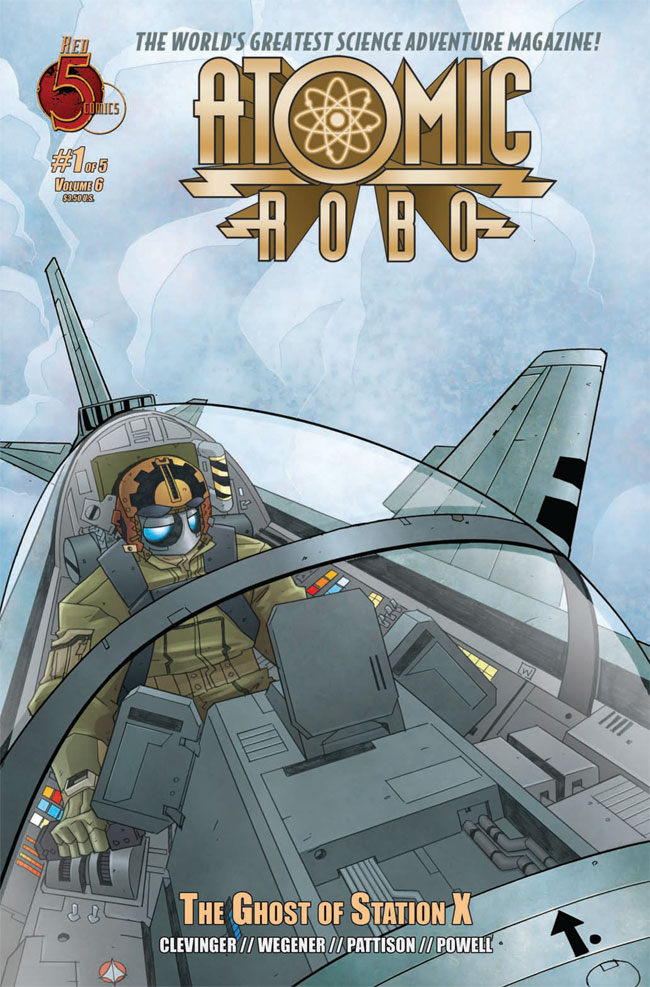
The Ghost of Station X is the 6th and latest collection. Robo and Tesladayne find themselves under attack from an enemy they can't locate. But what does this have to do with a vanished building at Bletchley, England, where Alan Turing, the tragic founder of modern computing, worked on the Enigma machine during World War 2? You'll be surprised.


This is an enormously exuberant series, far more clever and intelligent than the angular cartoony artwork would suggest. Robo himself is an engaging character being warm, witty and compassionate. It's simply the most entertaining comic I've read in a long time. Despite the all-ages tag, it isn't written down, rather it's written up. Ten year olds will enjoy it but on a completely different level to their parents. Greg Rucka, writing a puff piece (introduction), states he immediately gave it to his wife to read and then his 11 year old son (and presumably his servants if he has any -Lady Chatterly's Lover trial joke) and he was absolutely right to do so. Atomic Robo refreshes the parts of the imagination that other comics fail to do while allowing you to experience the sheer joy of Action Science.

So, you are no doubt asking, why don't I have the first three volumes in the series. Short answer: because they're all over £20 each and are out of print. A used copy of volume 3 is available for £49.95, a new copy for £1287.06. I think this last one might be a mistake and have emailed the seller to check. I'm hoping it might be £12.87 but realistically that's not very likely. I did manage to order a copy of Vol 2 for about £14.00 but was so excited I forgot to check the condition which is 'very good' which could mean anything.