Showing posts with label science fiction. Show all posts

Sunday, 13 April 2014

TV/DVD: CONTINUUM SEASONS 1 & 2


I picked up Season 1 last year on a whim and enjoyed it a lot, so much so that I watched it again just before Season 2 arrived which I then watched (all 13 episodes) in a couple of days and enjoyed it at least as much. 

The premise is superficially simple. A group of terrorists in 2077 are about to be executed but somehow escape to the present (2012) dragging along a Protector (cop) with them. Their intent is to change the past so that their future never materialises. The cop wants to stop them and get back to her own time and her husband and son.

The execution is far from simple. Our hero Kiera befriends Alec a teenage genius (who will become very powerful by her time), gets in with the local cops and partners up with good looking cop Carlos. Villains do villainous ruthless things except they think they're heroes and the problem is that they actually might be.

There's a flashforward at the beginning of each episode which gradually reveals more and more about Kiera's world which starts to look more and more like a dystopia run by and for the benefit of mega-corporations. It soon becomes apparent that Kiera was set up to go back in time, possibly by the old Alec.

The more the series goes on, the more devious it becomes. The bad guys turn on each other. Not everyone is what they seem. Not every thing is what it seems. Is Kiera there to stop the bad guys (Liber8) from preventing the future to happen as it did which does not seem to be a good thing? In which case she actually may be the villain. Or is everything pre-determined?  And then, towards the end of Season 2, we get the appearance of a third party with a different agenda that suggests a different possibility.

Basically this is really good intelligent,well thought out TV science fiction. There's plenty of action, plenty of character beats, more mysteries than you can count, and it's really impossible to predict what's going to happen next as revelation piles on revelation. In at least one case a man who is accused of murdering millions, and actually has done that, but the situation is far from what the viewer has been led to believe.

Here's a photo of some of the cast. Speculation on time travel in the series is continued below.


From l-r: ambiguous guy, our hero, good guy, bad guy, good guy (for now), very very bad guy.

How this series is going to end: the three possibilities.

The scenario which annoys me the most: the closed loop. Everything is self-contained. The future dictates the past which makes the future possible. See also: Dr.Who-Blink, Robert Heinlein's "All You Zombies". I absolutely hate closed loop stories because they depend on there not being a first cause which makes them logically impossible. It also makes the series totally pointless and if the series ends this way, fans will burn down the studio. I think it's the least likely option but I could be wrong.

The past is changed, therefore the future is changed. The fun with this scenario is how the future is (being) changed. It makes everything open-ended.

Changing the past does not change the future. It creates a new world with a different future; in other words, the alternate world shtick. This possibility is hinted at near the end of Season 2. 

I think that whatever happens, whichever of these three happens, Kiera will end up being re-united with her son and, possibly, her husband. 

I also happen to think that time travel is one of science fiction's most stupid tropes because on any logical level it doesn't make sense. Unless you accept that  travelling to the past automatically creates a new alternate world. I'm not saying it doesn't make for entertaining and thought provoking stories because it most certainly does, as does the parallel/alternate world concept. 

Anyway, Series 3 will be on Sky later this year and I'll be glued to it. Unless, of course, the past is changed and the show was never given the green light in the first place and you never read this post.

Monday, 31 March 2014

DVD/ BLU-RAY REVIEW: HUNGER GAMES: CATCHING FIRE (2013)

It immediately ocurred to me to compare this to the Twilight films and to Ender's Game to the detriment of both. In the case of Ender's Game, it's based on a science fiction novel (albeit the middle part of a trilogy) but unlike that movie it doesn't water down its source material. And, really, there is no comparison to Twilight which is a cliche-ridden trite vampire romance. Catching Fire (and I also include its predecessor in this) is vastly superior to both. 

This series is rich in substance, packed with subtext, drenched with genuine emotion, and feels completely believably real. 

As the film opens, Katniss is back home in District 12, the most depressed, downtrodden and oppressed of the 12 districts, though most of the others aren't much better. She's become a symbol of hope to the masses though, as she admits to the President who wants to destroy her, all she wanted to do was survive. Despite that she's forced by events to be that symbol and, at first, even her phony boyfriend, previously a bit of a wimp, displays more moral strength than she does. As they go on nationwide tour to publicise their victory of the previous year and demonstrate how powerful the government is, discontent spreads. So, in order to first destroy her heroic image and then kill her, a new Hunger Games is announced consisting of previous winners which then takes up the second half of the film.

The second part of a trilogy (though the films have been extended to a quartet and may the inventor of the word quadrilogy burn in hell forever) is always the hardest to pull off but this works well building on the first film and intensifying certain aspects of it. It'll be interesting to see how the two films based on the third book do when there are no Hunger Games to focus on.

Jennifer Lawrence is, as I've said before, the best young (under 25) actress around and here she displays as thoughtful a nuanced performance as she does in more mainstream roles. 

Two films in, this is the best blockbuster series around: exciting, intelligent, thoughtful.


Tuesday, 21 January 2014

FROM HANK JANSON TO THE POSSIBILITY OF INTELLIGENT EXTRA-TERRESTRIAL LIFE, WITH APPROPRIATE DIVERSIONS.


Who is Hank Janson? some of you are wondering. He’s someone who doesn’t exist. He’s the hero of over a hundred lurid faux-American tough guy crime novels, which are ostensibly written by him but in reality are the work of more than a dozen hack British writers, published during the 40s and 50s and now mostly and deservedly forgotten.

But wait! I want you to imagine that this is the standard by which Crime Fiction is judged by those not familiar with the genre. When people (such as The Sunday Times’ AA Gill) think of CF and judge it, they think, not of writers of the likes of Conan Doyle or Raymond Chandler or PD James, but of Hank Janson and lesser writers of ‘his’ ilk. It is a genre to be sneered at as those who pontificate on this genre imagine its fans to dress up in trench coats and wear fedoras, secreting .45 calibre guns on their persons while female fans dress like sluts, exposing legs and cleavage and wearing bright red lipstick and fish net stockings. People to be mocked.

But this is a fantasy. It doesn’t happen because those who perchance to write on the subject all know better than that. And yet it does happen. It happens to Science Fiction.

In his monthly online newsletter of the SF community, Ansible, David Langford regularly includes a brief section entitled “How others see us” featuring published quotes by people on SF which show their ignorance and lack of understanding of the genre. It is both funny and saddening. Over 50 years ago Kingsley Amis (or it might have been Robert Conquest; memory fails with age alas) wrote words to this effect: “SF’s no good the critics cry/ But this is good/ Well then it’s not SF!” In over 50 years nothing, despite the enormously increased popularity of SF in literary form and in other media, has changed. It remains a genre judged by its worst examples.

Space opera and alien monsters basically, invasions and zooming about the galaxy in five seconds flat, massive space battles, aliens who are basically humans with enlarged ears or odd noses, lurid covers from pulp magazines, EE ‘Doc’ Smith (a turgid writer of intergalactic war who wrote long past his sell by date) and Edgar Rice Burroughs Martian novels. They have their place in the history of SF but the genre has evolved and become so much more. Much more than Star Trek and Star Wars which are their inheritors.

These people are, if not unaware which they mostly are, ignore the quality work of writers like Ursula K Le Guin, Brian Aldiss, Gene Wolfe, Nobel-prize winning Doris Lessing (who cheerfully admitted to writing several SF novels), Samuel R Delany, Iain M. Banks, and so many many more.

So too do they misunderstand the nature of SF. While admittedly SF can be about any damn thing an author wants it be, cheerfully crossing genres like a cross-dresser, the best of it is often  about aspects of contemporary society but tackled indirectly. Who can forget Fredrik Pohl’s vitriolic satires about advertising back in the 50’s, Johanna Russ on sexuality in The Female Man, Delany on mutable identity, or Leguin on political ideology in her masterpiece The Dispossessed which opens with a simple description of a wall that is a piece of symbolism and metaphor on a level with the tortoise crossing the road at the beginning of Steinbeck’s The Grapes of Wrath, or Banks on the supposedly discredited (not to me, by the way) ideology of socialism?

Lesser writers, however, are unable to transcend their era and merely reflect it, their fiction being an echo of contemporary values with no attempt to imagine anything beyond them. Inevitable, I suppose.

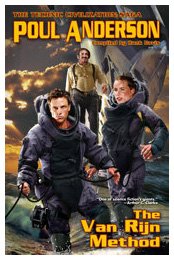
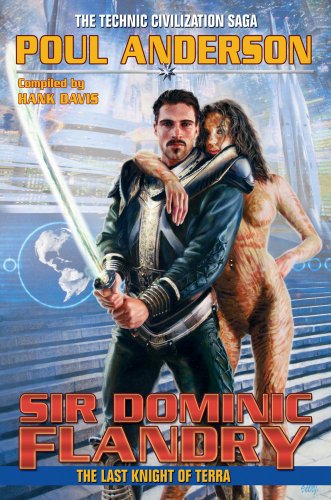
Which  brings me to Poul Anderson, a writer who is a paradigm of almost everything I’ve written thus far, whose recent reading by me (with only two volumes completed to date) of his massive 7-volume collected Polesotechnic League/Technic Civilisation future history stories has sparked me (I’m not going to be presumptuous and use ‘inspired’) into writing this piece which actually brings together a small number of things that have been knocking around the inside of my head for a while and wanting to be let out and resulting in a simplification of them all.


First of all Anderson is a very competent writer who has won several of SF’s major awards and when I started reading adult SF in the early 60s was one of the first writers (along with Asimov and Heinlein of course) to catch my attention. Although extremely prolific and with a career stretching from the late 40s to his death in 2001, he was no hack. With a scientific background, a gift for the creation and description particularly of aliens and alien landscapes, he wrote hard traditional SF. He also wrote Fantasy and many critics consider that side of his writing to be his best. I also remember a short novel of his (last published and probably never likely to be reprinted) published as half of an Ace Double (look them up) about a beer-powered space ship (so yes, he also had a sense of humour).

But a significant amount, albeit still a small proportion, of his writing came in his future history series. (Note: future history is when a writer produces a series of stories/novels with a consistent timeline.)  And basically Anderson’s came in the form of space opera albeit a highly superior form of it. It’s in this series that his strength and relative weaknesses are to be found. But it’s the latter that I’m more interested in here. Anderson (who probably voted Republican though that could be unfair of me) is an avowed advocate of capitalism which is the driving force in the first half of the volume until external pressures turn it into an Empire, not a republic and nothing so wishy washy as a commonwealth. Socialism appears long forgotten. Men are men and rule the spaceways with women as support. People still smoke like chimneys as they did when the stories were written. Racism, however, appears to be a dead issue as many characters are non-white and nothing is made of this, so fair do’s.

Technology is the one thing that always dates SF just as mobile phones do in ‘contemporary’ films made over the last twenty years. Here, while we have sentient computers their actions are still restricted by their programming and secret messages are passed on by microtape.

But what characterises this series is the premise that not only are so many worlds on which mankind can live that Earth can pick and choose. Also there are countless species of aliens at various levels of technology with whom our merchants can trade. All this is accomplished by space ships which can travel faster than light, much much faster than light. This is basically a standard cliché of SF and I’m not singling out Anderson. My reading his stuff came from a whim in which I wanted to investigate the SF of my youth to see if I still enjoyed it in my dotage -I already have several collections of other writers in nice NESFA Press editions- Anderson was a good writer, and these collections were cheap.

But it also got me wondering about the possibility of intelligent life existing on other star systems. No, actually it didn’t. Of course there is. What I wondered was that if this SF cliché of a fecund universe is correct then how come we haven’t found any evidence of it and the only conclusion is that…

Well let’s see.

First off we have to consider our innate intelligence. I’ve believed for some time that there is much about the universe that we are incapable of understanding or being aware of. If we can not conceive of it then how would we know to look for it? The simple divergence of intelligence in our own species is proof of that. I’m not a stupid person by any means, though I’m not that much above average either, and there is so much in everyday life that I don’t and can’t understand that other people do; the reverse also applies. From this position it’s not unreasonable to suppose that we could be being studied by an alien intelligence without ever being aware it. I should not that I put anal probes from outer space in the same box as the Loch Ness Monster, ghosts, demons, etc.

That said I also think it’s highly unlikely. My view, which could be completely wrong, is that Einstein got it right and that faster than light travel is impossible. Theoretical Physics can conjure up self-contained mathematical proofs that it is possible but it’s basically a circular argument.

It’s also pretty obvious from recent discoveries that planets which are even remotely Earth-like are very rare indeed. Which isn’t to say that alien intelligences don’t exist on planets which aren’t earth-like but, apart from the fact of the near impossibility of ever encountering them they would be impossible to communicate with on any meaningful level if we could even recognise them for what they are.

If there are any travellers between the stars they would have to be machine intelligences able to endure the enormous time taken to travel between solar systems. Their progenitors, a biological species would probably have died out before they’d visited even a dozen so one has to ask: what is the point?

I’m not arguing against SETI -the search for extra-terrestrial intelligence- I just think it’s unlikely to bear fruit. But then, like my certainty that there is no god, I hope I’m wrong.

But we need our dreams, our hope for something more. It can be found in religion (though not by me) or in the visions of SF which are no less transcendent. And no less needed.


Thursday, 18 April 2013

BOOK REVIEW -SCIENCE FICTION: GREAT NORTH ROAD by PETER HAMILTON (2012, 1087pps)

So how could I resist an SF novel with large chunks of it set in Newcastle 130 years from now, especially with a title like that?

(For newcomers to this blog, I should explain that I live in the City of Sunderland, a mere 12 miles south east of Newcastle. Both cities boast prominent football teams which are arch-rivals, particularly their fans and just last weekend Sunderland, the under-dogs, beat their rivals 3-0 away at Newcastle. As a result a few hundred Newcastle fans trashed their own city centre which gives you an idea of the mentality of the Newcastle United supporter. This has nothing to do with the review, I just wanted to mention it.

(On the other hand, the Great North Road refers to the A1 which starts down south and continues all the way up to Scotland. The Romans built the first one nearly two thousand years ago. In this novel, however, it also refers to a road that leads to another planet on which the rest of the novel takes place.)

You may have noted the page length of the novel. This does not include those pages devoted to the timeline prior to the start of the novel nor the list of key characters and their functions (e.g. detective). It's a very long book which took me only five days to finish.

As I don't do long reviews -I write reviews not criticism- it's very difficult to briefly summarise the plot. But I'll do my best. 

It's triggered by the discovery of a body, one of a clone family of industrialists, who has been murdered in a unique way that was only seen once before and the woman found guilty of the early murders, which included another clone, is still in prison; also the clone can not be identified. A local detective is put in charge of the case and what is discovered prompts a military expedition to a colonised world, which provides vast quantities of bio-fuel, in search of a previously undiscovered deadly alien species and is accessed via the Newcastle gateway.

Woah! That's not bad even if I say so myself. 

Of course it doesn't begin to even hint at the richness and complexity of this terrific piece of SF. There are so many things that Hamilton does so well. 

His portrayal of the not quite near future is comprehensible and accessible. My view of the future is that it's not unlike the present only with twiddly bits. Not that many years ago I took my first look at Sunderland's new bus station from which is visible a new shopping complex and it looked like the future as seen from 1950's illustrations. And yet in between bus station and shopping centre were several buildings which have remained pretty much unchanged in nearly 60 years or more. The future, with twiddly bits. People still go to pubs and chat up women while every dust mote is a camera watching everything. Well, almost. Many car accidents are caused by drunks who won't let the car drive itself.

He doesn't lay it on with a trowel but global warming has given the north of England long winters full of blizzards and snow drifts and short hot summers.

The main foci of the novel are the detective and his team trying to solve the murder and identify the victim and the story of the woman, who was found guilty of the original murders and claimed it was an alien, who goes to the alien world with the military expedition. In one sense it's a mystery novel set in the future with both plot strands essentially being attempts to solve a mystery which ultimately has one solution.

Hamilton uses his flashbacks well, revealing only part of an incident which suggests one thing only to show something different when it is continued. Characters who appear to belong to different subplots are revealed to be closely connected. Sometimes they're even the same person.

Frankly I stand in awe of the author who juggles so many different things yet manages to bring them all together in what is finally revealed as a gloriously woven tapestry.

If you want a book to lose yourself in, this is it.


Friday, 27 July 2012

BOOK REVIEW: THE HOLY MACHINE by CHRIS BECKETT (2004)

Science Fiction used to be pretty much the centre of my life from about the age of 20, when I first found out how to get American imported paperbacks, up to about 35. Mind you, I can't ever remember not loving SF even before that, ever since I realised what it was. I just could not get enough of the stuff and built up a pretty enormous collection. I was also very active in SF fandom, publishing my own fanzines and writing for others. In my thirties I became obsessed with writing the stuff, well, and just writing novels per se. 

But eventually I moved on with crime becoming my favourite genre fiction. I never completely lost my ties with fandom, though any connection with it these days is quite tenuous and thread-thin. Writing fiction became an occasional dabble in which I currently seem to have no interest at all, with blogging fulfilling my need to communicate and write and the main focus of my attention can be found in my other blog.

But I could never give up on SF even though I rarely read it any more and am often disappointed with what I do read. Still I keep trying the odd book from time to time like the one I'm reviewing here. This came to my attention as one recommended by Amazon following a spate of buying some Urban Fantasy books (which I keep intending to review en bloc). Don't know what it's got to with that genre but it nevertheless intrigued me and I finished reading it a couple of hours ago and, yes, the comment from an Interzone reviewer on the cover about is quite correct.

When I first started reading it I wasn't sure at all because the background scenario has to be my worst nightmare. In a reaction to secularism and science, there is a worldwide mass uprising of fundamentalism from all religions and sects (though Judaism and Buddhism aren't mentioned) sending the world back into a modern version of the Dark Ages. To counter this, Illyria, a high-tech country, is created in a region of the Adriatic which is where George our protagonist lives.

George isn't the usual SF hero, being diffident, despite being in his 20's he's never been kissed, and has a mother who prefers to spend her time in cyberspace. But, just as I briefly outlined about my life, things change. He falls in love with a human-like sex robot in whom he senses an emerging awareness not related to her programming. When the increasingly fascist government decides to wipe the minds of robots every six months, George goes on the run with her through bordering religious states which, incidentally, hate robots even more than they hate unbelievers.

This is an absolutely fascinating novel which looks at the nature of consciousness and simultaneously both the need for a belief in religion, in something transcendent (which might also be consciousness) and how (to many cheers from me) bloody fucking imbecilic and irrational religions are. It's thoughtful and clearly written which engages the reader, despite George being very much an outsider, though his life and his perceptions of the world undergo a profound change during the course of the novel.

In short, I absolutely loved this book which reminded me why I loved SF -its alternative pluralistic views of society (as well as unfettered imagination)- in the first place. As far as I can tell, it didn't win any awards which is a shame. Anyway, I've just ordered Beckett's other two novels and added his short story collection to my wish list.

This is the book that you give to people who think they don't like SF. It has a heart and a brain.

Sunday, 24 June 2012

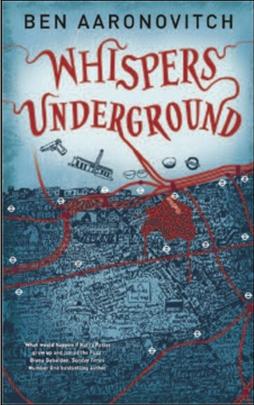
AMAZON BOOK REVIEWS: THE LONG EARTH by TERRY PRATCHETT/ STEVEN BAXTER and WHISPERS UNDERGROUND by BEN AARONOVITCH


4* Interesting idea

The idea of parallel earths is hardly original as it goes back at least ninety years in the history of Science Fiction to a story by Murray Leinster. Baxter and Pratchett do something a little different with it by firstly creating a potato-powered device which makes it easy to step into another world and secondly by having humanity non-existent in all of them but our own. Needless to say the two authors work well together and create a book which is different from either of their individual work but just as good. So don't go in expecting a Terry Pratchett story or you'll be disappointed.

It's highly readable and I could (have not other things got in the way) have read it in one session. There is so much potential in this scenario that it's inevitable the authors will end up surprising the reader as they take the story in unexpected directions. After finishing it I kept wanting to ask the authors about several things which occurred to me.

There's the (in)convenience that iron won't cross into another world with severe limiting effect (never mind that you can't take more than you can carry). This makes industrialisation exploitation very difficult. This is never explained but it suits the purposes of their story. Do they have a logical reason behind it?

The result of all this is that akin to a pioneering frontier type lifestyle similar to that of the colonisation of America only without the Native Americans. Some way into the story we learn that a fifth of the world's population have stepped over. Really? A fifth (or more -see a following point) of affluent societies have forgone their comfortable lifestyle to become pioneers. Sorry, but I for one like the creature comforts of a high tech society.

Also, while I know it's set a little way in the future and the device is relatively cheap. It would be difficult for those who would really need it to get their hands on it. I'm thinking of the majority of Africans who suffer from famine and oppression and lack of education. How could they get their hands on the electronics needed? Come to that, how could they get their hands on a potato?

None of this affects the story, it's just stuff that I thought of as a result of the story and doubtless there are numerous more implications or omissions to be found. This is actually another reason why you should buy this book -it makes you think. 


4* Is this man prolific or what?
 
This is the third book in the series in little over a year and shows no decline in quality. Instead, more secrets of London are revealed as seen through the eyes of Detective Constable Peter Grant (apprentice magician) our engaging narrator. This time, as the title suggests, the secrets are underground.

I started reading this around lunchtime and finished by early evening which tells you something about its readability. If you haven't read any of this series before, start with the first. But don't worry, it won't be long before you're reading this one. You won't be able to help yourself. Great fun series.

All right, Aaronovitch, when's the fourth one coming out you lazy sod?

Wednesday, 30 May 2012

BOOK REVIEW: FURTHER-BEYOND THE THRESHOLD by CHRIS ROBERSON


This is an expanded review which recently appeared on Amazon that, at the time of writing (30th May, 2012) earned 28 positive votes out of 30 (28/30) which is quite a large number by my usual standards –anything over 10 votes is exceptional. Mind you, it was the first Amazon UK review of the book and being the first gets more attention. (The book itself I got for free, a proof copy for review without the snazzy cover shown above.) I think it’s possibly because, having seen a specific criticism on amazon.com, I opened the review with my argument against said criticism. I’ve revised it for this blog because I wanted to go into a little more detail.

The 4 star review’s title is: Enjoyable far future adventure.

That's 12,000 years plus in the future without any back to the Stone Age disasters in between. This immediately sets up the argument that such a period of development would create a society incomprehensible to modern man. I disagree for a couple of reasons. The first is that we are already technologically advanced and just because we can't understand how something futuristic works doesn't mean we don't recognise it for what it is i.e. the product of science. 

Arthur C. Clarke once wrote, or in words to this effect, that any sufficiently advanced technology is indistinguishable from magic. This sounds a clever thing to say when he said it decades ago but looking at it now it just sounds glib. It doesn't look like magic to our eyes, it just looks like technology. Having second thoughts, I don’t think it was a clever thing to say even then, it just sounded clever and, coming from the great man himself, it gained a lot of attention. I’m not being facetious here. Clarke is important in the history of science fiction and in populist writing about science. He was a genuinely creative thinker. But in this case he was wrong by, at the very least, a couple of hundred years and probably more.

The Renaissance brought about a great change in the way we saw the world, in particular that we are just a part of the universe and not the centre. For the next few hundred years, we saw the evolution in thinking about what call Science which exploded with the Industrial Revolution. A reasonably educated mid-Victorian would not be shocked or overwhelmed by contemporary technology once s/he’d had a change to take it all in. The changes in society would be far more overwhelming. 

The second reason is that, while it goes without saying that society will be vastly different in the future, it's unlikely that our basic intelligence will have changed much. 12,000 years is a blink on the evolutionary scale and I don’t think that it’s altered significantly since the invention of writing and probably longer. Of course there’s always the possibility our intelligence could be enhanced by genetic advances but I’m not going to go there. My argument is that society a few thousand years in the future may be strange to our eyes but it won’t be incomprehensible.

What Roberson does is to create and deftly portray to the reader just such an advanced society as seen through the eyes of an astronaut born a couple of centuries hence. The first half is concerned with our hero RJ finding his way in the new world and the second with his command of the first ever FTL spaceship. I should note that thousands of worlds have been populated by means of (wormhole powered gates and getting from one world to another is as easy as walking through a door. There's a varied collection of supporting characters, some human, some A1, some enhanced animals (including cats, dogs, chimpanzees and killer whales), but all intelligences are considered by society to be human. Except by...

Which is where the conflict comes in and the novel climaxes with an encounter with the 'except by'. It's all very readable and a promising start to this new trilogy. I'm looking forward to getting my hands on the next one.

Sunday, 9 January 2011

SCIENCE FICTION: ON MY 'TO BE READ' SHELF

If cats were my first real love that has stayed with me all my life, Science Fiction runs it a fairly close second. When I was about four or five and started reading the British weekly comics, it wasn't long before I knew the type of material that I really liked and was that space stuff, starting with Captain Condor in The Lion-
-and followed not long after by Jet Ace Logan.
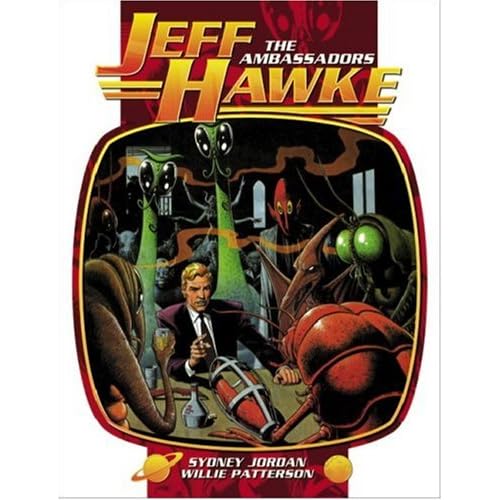
 The sublime Jeff Hawke followed later.
By that time I'd joined the library and, although an omnivorous reader, was always on the lookout for the space stuff and by my mid-teens, although still devouring anything and everything, was a confirmed fan of SF. When I met Susan at the age of 40 I'd amassed a sizeable collection most of which I then had to get rid of (along with a similarly large collection of comics) when I moved into her small flat. It wasn't such a big deal then as it might have been ten years earlier as I'd been reading less and less and more and more crime fiction for some years, plus anything else which took my still omnivorous fancy. I'd also found myself on the fringes of SF fandom after years of involvement when it had become the focus of my life.

Over the next 20 years I found myself reading less and less SF, though still interested, and maintaining only slenderest toehold in fandom. Now in the last couple of years I've found myself buying SF again, not a lot and very selectively. I've mentioned this from a different angle before but bear with me if I repeat myself somewhat. It started with a couple of collections from Gollancz which were both nicely produced -Robert E Howard's The Complete Chronicles of Conan, an edition which deliberately shed the post-mortem additions and rewrites by L.Sprague de Camp and Lin Carter to present the stories in their original form, and Necronomicon The Best Weird Tales of H.P. Lovecraft which, excluding collaborations, is actually pretty much the complete HPL and has a nice extensive concluding essay. Any, yes, I know they are respectively Fantasy and Horror and not SF but as far as I'm concerned the three genres are heavily related (though I could equally argue otherwise). In January 2006 I bought a lovely 600 page hardback The Jack Vance Treasury. I can be specific about the date because that was when I went into hospital for four weeks and read most of it there.

I then bought several books published by NESFA Press starting with the massive 6-volume set The Collected Stories of Roger Zelazny which I've written about elsewhere in this blog, before moving on to the remarkable Cordwainer Smith, Charles L Harness, an author little known outside the SF community but influential within it, and several others -I'm not doing a complete list.
In case you aren't au fait with the genre, most of these precede the 1980's and indeed some date from the 1940's. They are also almost completely short (well, shorter than novel-length) fiction which is unusual for me as I normally prefer novels. But you are correct if you suspect it's a bit of a nostalgia trip. It is, though I find little to enjoy in modern SF, allowing for a number, if not numerous, exceptions like Ken  Macleod's The Restoration Game (which I got as a freebie).

The most recent book I bought (which I picked up new in hardback and for under £9.00 from an Amazon Marketplace dealer) is this one-
The stories are selected by Wolfe himself, which makes me query the use of definitive as authors are not always the best judge of their work, who writes a brief afterword to each story.

For those who believe SF is literature this is probably the best example of single-author short-form SF you could possibly have and I would match this against any other contemporary American author's short fiction, any other. Wolfe is not a difficult writer to read but he is deceptively subtle and there is often far more going on beneath the surface of his work than is readily apparent. I've read perhaps about a third of the stories before and those many years ago. I'm going to take my time with this book and savour these fine subtle stories and then I will put it back on the shelf where it will nestle next to a NESFA collection by A.E. Van Vogt and author who, despite writing very vigorous and idea-packed stories (mainly in the 40's & 50's) is not one who would ever be acclaimed as a literary giant but who is still fun in a cock-eyed way. GW and AEVV, two very different sides of the coin that is Science Fiction.

Monday, 14 June 2010

BOOKS, CD: RECENT SHORT AMAZON REVIEWS

Voodoo Child: The Jimi Hendrix Collection (Audio CD)
The Jimi Hendrix Starter Pack -a 5 star review.
This isn't all the Jimi Hendrix you'll need but it is the best place to start listening. If you don't like this then you just won't like anything else he's done. Hard to believe but there are some people who don't like Jimi Hendrix but then they probably don't like rock and blues electric guitar anyway  
As an introduction to Hendrix this can't be beaten, though it can be argued that various alternate takes of famous tracks which, while attractive to the hardcore fan, do the official versions (i.e. those that appeared on his albums) a disservice. I certainly prefer the original All Along The Watchtower to the alternate take which appears here. That said, CD1 can't be faulted as a comprehensive selection of his studio work. 
CD2 is a sampler of the many live recordings which have been released since his death. There's no doubt that Hendrix was brilliant live. Rougher is undeniable and understandable as his studio material was meticulously put together. There are only two live versions of tracks on the first CD and, like the rest, are noticeably longer with a whole lot more energy. Hendrix was as good live as he was in the studio, just in a different way.

After this, the only way to go is to his official studio albums and after that dive in to the plethora of live albums. Me, I rather like the compilation Blues which, surprise, focuses on his bluesier side. Me, I'd like a Blues vol.2 but sadly there's no sign of one.

I must mention the brief but fine liner notes and reasonably detailed track listing.

So, here you are: an excellent introduction to one of the greatest rock artists of all time. How can you resist? 

 
Sparky! A 4-star review.

Other reviewers have given an adequate plot summary, so I'll spare you that. Well, not you, the Amazon readers. You get the synopsis. A mutant virus has turned thousands of Bostonians into zombies -just not the cannibalistic kind of George Romero- so other supernatural creatures have come out of the woodwork, including our heroine.

To be honest, this isn't that much different from all the other paranormal adventures/romances going around. It's set firmly in the genre of attractive and powerful female in the modern world plus supernatural entities, handsome men who may be heroes/villains/romantic interest candidates, etc. No different, just that little bit better which makes it a good read. The author is currently at work on a sequel and I'll be in line when it's finally published. Read this and I'm sure you will too.


  A E Van Vogt for the 21st century, a 4-star review.
If that means nothing to you, let me explain. Van Vogt was part of the Golden Age of Science Fiction, a term that tends to refer to the 1940's and 1950's which was essentially a period in which modern SF as we know it was born. Writers who emerged then include the greats such as Asimov, Heinlein, and Sturgeon. And A E Van Vogt. Van Vogt was known for his mind-boggling concepts and galaxy-spanning stories and this is where Wilson resembles him. Except that Wilson writes very well, has characters who act like believable human beings, and his stories make sense.

Start to read Darwinia and you think: aha! this is a parallel world novel. When actually it's nothing so simple and what it's actually about is one of those mind-boggling concepts which, unlike old VV, makes sense and really does boggle the mind. This is the third novel of Wilson's I've read and I have three more on a table next to me. While they do vary in degrees of satisfaction, I've enjoyed every one and eagerly anticipate the next book of his I'm going to read.

Mr Wilson, you're terrific. 

Monday, 31 May 2010

BOOKS/DVD: MORE AMAZON REVIEWS

Killer Movie DVD 

Not bad but could have been better.

That said, the movie does have a fair bit going for it. Not least is that every time you think you know who the killer is, the real one promptly kills them. I was absolutely certain I knew who it was only for the guy to have his throat cut less than a minute after I'd definitely made my mind up it was him.

There is an attractive cast of good actors like the likeable Kaley Cuoco (The Big Bang Theory) playing an obnoxious actress, who I'm sure wasn't remotely based on L*nds*y L*h*n, who isn't as horrible as she first appears. Nestor Carbonell is great as a cynical agent and Paul Wesley of the Vampire Diaries is good as the lead. The rest of the supporting cast is fun as well particularly the actress who plays the utterly vile and predatory lesbian producer.

Much of the gore tends to be offscreen like the Cheerleader coach's encounter with a rotary saw (just when I decided she was the killer) or the beheading early on (when I'd decided that this character would probably be the Final Girl). Then there are more explicit bits like the throat slitting (see above) and hand amputation, so it isn't all bad. Plus there is a very high body count so that even at almost the very end you still just don't know who the damn killer is.

But I didn't find it very suspenseful and never remotely adrenalin-inducing. In fact it's oddly likeable for a serial killer movie and it is certainly surprising. Give it a try and it may surprise you.

Let's say the rating is three and a half stars. 


4.0 out of 5 stars Robert Charles Wilson is one of the best Science Fiction writers around., 30 May 2010
Or so I've come to believe after reading just two of his novels, the other being the award-winning Spin.

Like Spin, Wilson sets up a rather marvellous scientific problem against a very human background. Set several decades hence, three writers arrive at a scientific complex where, via a marvellous machine, humans can observe daily life on a planet over 50 light years distant. Then, for seemingly no reason, the complex is complete cut off with supplies arriving by a robotic drone. What the heck is going on?

This isn't action SF, instead we view events through the eyes of several characters, all of whom have problems which cause them to react differently to what is happening. Not a lot actually does happen but I was rivetted and really did not want to put this book down as I wanted to find out both the nature of the mystery and its effect on the protagonists. If I say much more I'll only spoil it for you.

So, after reading just two of Wilson's novels and immediately after finishing this one, I went and ordered four more from Amazon. I don't think I'm going to be disappointed. 

Tuesday, 12 January 2010

DVD: CLASSIC SCI-FI


Seven Science Fiction movies from the 50's which, I would like to say, greatly influenced my early love of SF, but it wouldn't be true. I only saw one of these at the cinema and that was The Incredible Shrinking Man (1957) which probably saw in 1958 when I was around ten. The rest I saw some years later on tv. With the exception of Tarantula! (1955) and, to an extent, Creature From The Black Lagoon (1954), they can all be considered early classics, or landmarks, in SF cinema and this, for the price I paid (less than a tenner), is good value to have this collection in its individual slimline cases.

I excepted Tarantula! and Creature on the ground that they're creature-features rather than genuine SF. The former is bog-standard stuff (you can see the real tarantula's legs partly disappearing from time to time), the latter is very good of its type (the monster not being completely unsympathetic) and both were directed by Jack Arnold.

Arnold also directed the terrific Shrinking Man which holds up really well and It Came From Outer Space (Jack Arnold, 1953)which probably looked much better in its original 3-D, at least to judge from the comments in the accompanying documentary. The latter is unusual in that aliens look totally alien and aren't bad guys. This can't , of course, be said for Invasion of the Body Snatchers (directed by the great Don Siegel, 1956) which still holds up as a masterpiece of paranoia and as the best version of the story, even with the studio-imposed happy ending.

That leaves The Thing From Another World (1951) and the only film in the set to get a 12 rating as opposed to PG. Debate still goes on over whether or not Christian Nyby directed it or producer Howard Hawks. Oddly, I like it better than when I first saw it, though I love John Carpenter's body-popping remake. Lastly is This Island Earth (1955) an early space-opera which is rather overshadowed by its contemporary Forbidden Planet but is still one of the influences on Star Wars. It's also the only colour movie in the set, though there is also a colourised version of Body Snatchers to choose from -but don't.

Apart from It Came and Creature which both have decent documentaries and other stuff, these are very much bare bones editions -trailer and subtitles and that's it. Still, it's a nice set for an  sf movie fan.

Monday, 9 November 2009

SCIENCE FICTION: THE REDISCOVERY OF CORDWAINER SMITH


We’re talking mid-teens to mid-twenties when I read Cordwainer Smith, maybe from around 1964-1974, maybe a little earlier, maybe a little later. We’re talking about the time when SF was hard to come by compared to today’s embarrassments of riches. We’re talking about the time when I was either at school or a student with little money to build up a meagre SF collection. I read every hardback SF in the library that I could find –the branch library round the corner, the school library which had some SF Book club editions, and late the college library with its small fiction section. I bought American SF magazines picked up cheaply in newsagents and second hand bookshops –Astounding/Analog, The Magazine of Fantasy & Science Fiction, Galaxy and its companion magazines Worlds of IF and Worlds of Tomorrow. It’s possible I favoured Galaxy which had a flavour of social SF which made it more accessible and appealing to me. I do remember it often featured stories by Cordwainer Smith with their memorable titles and strange stories that were as memorable as their titles, though I remember most well the surreal Alpha Ralpha Boulevard (published in F&SF) which could have sprung from a painting by Salvador Dali (another early enthusiasm of mine).
Now it’s nearly forty years later and distanced from some of the enthusiasms of youth and have moved some way away, but never out of sight, of Science Fiction. Perhaps, like many others before me, I felt that it’s SF which has left me and not the other way around as when in the mid-60’s a new generation of writers with better skills began to displace the old guard which looked faded and dusty rather like EE Doc Smith did to me back then. But, just recently I’ve felt an urge to return to the SF of my youth, to reinvestigate it, to see if it could still charm me, or to see if I really had moved out of its neighbourhood.
A newly published attractive set of volumes containing the complete short fiction (and much more, and with two more volumes yet to come) of Roger Zelazny had just appeared from NESFA Press and I bought all four from Amazon.com and I’ve just finished reading the first. An impulse buy, a 900 page collection of Henry Kuttner & CL Moore of which I’m currently 200 pages in. Robert E Howard’s The Complete Chronicles of Conan, the stories in their original form before Carter & De Camp buggered about with them has been sitting on my shelf for over a year and soon to be joined by a companion volume of Howard’s other fantasy heroes. 


And then there are NESFA Press’s two volumes of the complete SF of Cordwainer Smith: The Rediscovery Of Man (all his short stories) and Norstrilia (his only novel). Originally published by NESFA in the 90’s, they’ve been kept in print in these solid editions ever since and the Science Fiction world should be suitably grateful.
We all know that Cordwainer Smith was really Paul Linebarger, a diplomat and expert in Far Eastern affairs, a man with important political connections, who died at the terribly early age of 53 when he was probably coming into his prime as a writer and would, no doubt have otherwise delighted us for many years to come. He had a new cycle of stories already planned.


And I think I’ve answered the unwritten question: do I enjoy his stories as much as I did when I was young? Yes, yes, yes. Perhaps I appreciate them even more.
Almost all the stories share the same timeline, albeit one spanning thousands of years and here they are published according to their internal chronology, rather than their publication date, in order to convey a coherence which otherwise might be lacking. The title The Rediscovery of Man refers to a period when the Instrumentality, the rulers of humanity, have allowed some danger back into the lives of the cocooned conditioned humanity. Norstrilia the novel is chronologically towards the end of the era and should be read after the stories as characters from some of them are either referred to or appear.
What is startling and so good about these tales is that they are not written from a conventional perspective. It is as if they were written in the future when their concerns are different from ours, when humanity is not quite as it has been. The narrator knows the end of the tale and often cheerfully informs us, the reader, of it and allows the story to proceed matter of factly to its inevitable end. We are presented with a story that is known to those of its time but are privileged to learn the secrets behind the story, the reality behind the myth, the final true fates of its protagonists.
So welcome to the future of the scanners and pinlighters; the Underpeople and their heroes D’Joan (whose story echoes that of Joan of Arc), T’Ruth the strange turtle girl who helped Casher O’Neil take back his stolen world, and C’Mell who saved the boy who bought the Earth; the return of pain and danger to Man; the secrets of the planet Shayol and Mother Hitton’s Littul Kittons; and wonders more strange than anyone could have imagined except Paul ‘Cordwainer Smith’ Linebarger, SF’s best kept secret.