Showing posts with label fantasy. Show all posts

Thursday, 18 July 2013

DVD (BLU-RAY): HANSEL & GRETEL WITCH HUNTERS (EXTENDED CUT, 2013)


When this came out at the beginning of the year, the critics and reviewers dumped on it from a great height. Even the fan press (specifically the Internet-based genre fans) was pretty cool. From the clips I'd seen it looked like a dumb popcorn movie but a fun dumb popcorn movie. Well, the general impression I got from reading the reviews was that I got everything right except the fun part.

But what the hell, I took a punt on the film when I could get the blu-ray for a tenner. And, well, either the critics were wrong or the extended cut (by around nearly ten minutes) was a whole load better because while I couldn't say I loved it, I certainly liked it a lot. and for lots of reasons, not the least being that it happened to be a shitload of fun.

For a start it was written and directed by Norwegian Tommy Wirkola of cult hit Dead Snow, the gory Nazi zom-com which I'd liked. In an extra, he tells us that as part of Australian film course he had to put a pitch for a movie and pitched this. His lecturer told him to never mention this again until he could put it to a Hollywood producer and it would sell immediately. So that's what he did and that's what happened.

The premise. Traumatised while young by being dumped in the forest by their parents, fattened up for the pot by a hideous witch whom they subsequently kill, they grow up to be witch hunters. The growing up is shown by torn pages from newspapers (with woodcuts as pictures).

Set in Germany some time after the industrial revolution has begun -H&G's weapons are too sophisticated in a steam-punk sense for it to be any earlier- and in and around a small town surrounded by forest and mountains. Local sheriff, (actor Peter Stormare), is in full crowd-rousing form as he urges them to burn an attractive young woman because she's obviously a witch.
How does he know? Because he just fucking knows, that's how he knows and you're starting to look a bit witchy to him so shut the fuck up. His rabble-rousing is interrupted by Hansel and Gretel who've been hired by the mayor to put an end to the local witch stuff. Hansel quickly explains why the attractive young woman couldn't be a witch because -after roughly examining her teeth as if she was a horse- she's too fucking attractive to be a fucking witch so stop bothering her or he'll fucking bother with you. Got it? (And if you're wondering why I'm fucking swearing so much it's because everybody in the film fucking swears all the fucking time and yes it does get a bit fucking wearing after a while.) Stormare is pretty pissed off by this and calls Gretel a whore who says nothing but abruptly steps forward, headbutts him and breaks his nose. (And you think there's going to be more to do with the attractive young woman who isn't a f.. sorry.. witch, you're right.

Okay, witches are ugly. Here's our chief witch as played by Famke Janssen (and, yes, this is her in ugly witch not just a bad mood after a night on the town mode). She's building up to create a witchpocalypse by kidnapping specific children for a ritual. Feel free to hiss and boo her, she's used to it.

I should, at this point, mention our lead actors, Jeremy Renner and Gemma Arterton. Renner is a mean moody action hero. Arterton is a more subdued but still mean, moody and demurely sexy action heroine. I've recently come to the conclusion that any film Gemma Arterton is in is worth watching because Gemma Arterton is in it. There's good brother-sister chemistry between them. They and their stunt doubles (Arterton, in an extra, hugs her stunt-double and sings her praises) are very convincing in the action sequences which are very well staged and there's plenty of them. 

The special effects are excellent on every level. There are some gloriously hideous witches including a pair of Siamese twins joined at the back.They can not only fight standing up but
scuttle around on all fours. (If they take turns, should that be all eights?) The gore is appropriately splattery with splattered heads, decapitations and limb-lopping by the bucket load. and what's really surprising is that much of the effects are mechanical and practical rather than cgi. Wirkola says that he used cgi to enhance rather substitute. I was amazed that Edward the Troll (the witches' servant who totes that bale of kids on his back) was mostly a man in a suit.

Incidentally, the story is cleverer than you might expect as there's a major revelation towards the end that concerns the location and their past. And it's also funny but not in the evilwitch-com sense.

This is way way effing way better than you might imagine. You'll laugh, you'll cry, you'll sigh, you'll go eeeurgh! Definitely my under-rated movie of the year.

(I did review this on Amazon but this is the fucking uncut and fucking drastically better version. Got it?)

(Okay, it is a load of rubbish, but it's still great well-made entertainment and I'm going to watch it again soon.)

Thursday, 23 August 2012

URBAN FANTASY AND THE DECLINE OF THE HORROR GENRE

1. Characteristics and recent examples of Urban Fantasy.

"There's a lot of it about" was the accurate title I gave to a review of  The Dirty Streets of Heaven, the first in a new series by Tad Williams. The 'it' being Urban Fantasy. It's easy to characterise or define this newly emerged genre as it has very clear characteristics.

It's set, primarily, in an urban environment (though it can include the suburbs or even visits to the country.

It contains at least one magical or supernatural element, but usually several such as vampires and their ilk, humans with magical powers -witches/magicians etc, demons and angels, ghosts, non-human humanoids such as elves, faeries,trolls, etc .

It may be set in a parallel world where these fantasy elements have been revealed to the general public to exist (the Sookie Stackhouse series to name just one of many, aka True Blood on TV) or are hidden under the surface of our world.

While generally contemporary, it may be set in the past.

Despite what may appear fairly narrow proscriptions, UF is actually a fairly adaptable sub-genre of Fantasy which, I'd argue, includes another popular sub-genre which narrowly preceded it -Paranormal Romance. It lends itself well to police procedural such as Justin Gustainis's Occult Crimes Unit series or, on TV, Grimm. But the potential scope is enormous. The form is also very popular among teenagers to just from the number of UF teen series published.


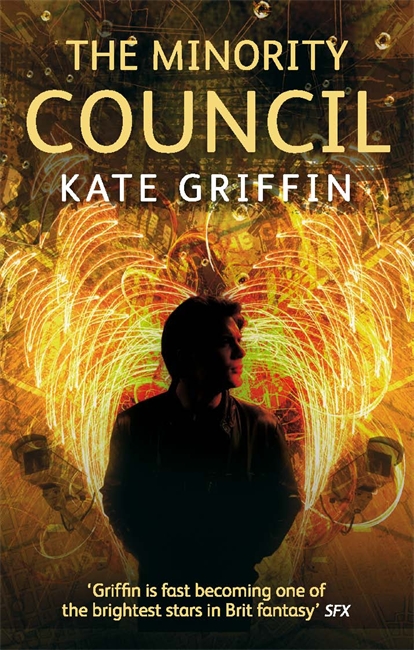
The reason I mention this is because just recently (i.e. in the last few months specifically, but intermittently for a number of years preceding that)  I appear to read and enjoyed a lot of UF. Kate Griffin's series (four so far) about Matthew Swift, a young sorcerer brought back from the dead with something extra, is a love-letter to London with evocative highly detailed descriptions and prose and an imaginative take on magic in the modern world. (Aside: Ms Griffin is actually also known as Catherine Webb who has written several well received teenage novels starting when she was only 14. She has now reached the venerable age of 26 and writes with the confidence and ability of someone twice her age.) Ben Aaronvitch similarly writes about London but from the viewpoint of a young mixed race copper with slight magical abilities working for a mysterious boss who is a senior police officer. The excellent Rivers of London is the first (of three) in the series and there's a new one coming along any minute now. In Benedict Jacka's Fated, our hero is a Camden-based magician with a gift for seeing the future -all possible futures. He avoids other magic users because they're all treacherous bastards. The third in the series is out soon. 

And these are only the series I've read in the last few months and which, obviously, I recommend as thoroughly entertaining.

2. The decline of horror.

I really should qualify that because, as it stands, it isn't completely true. Horror as a genre still thrives in the short story form and as movies in the cinema, or, more likely thanks to the endless appetite for low budget zombie movies, in direct to video form. The Sy-Fy channel also churns dozens of forgettable monster movies usually about mutant/prehistoric sharks, snakes, spiders, and crocodiles.

Horror is decline in terms of novels because the tropes of horror have been appropriated and adapted by what has become Urban Fantasy. The traditional monsters of horror -vampires, werewolves, etc- have now been transformed into part of modern society. They may  still be a threat, or misunderstood, or romanticised, but they are no longer the great unknown, the unknown demon in the shadows as they were traditionally portrayed. They no longer represent the visceral threat from which Horror draws its power. The number of classical mode horror novels (cf Joe Lansdale) published declines every year as more and more UF novels appear.

As this is only a short piece (I'm too lazy or have too many other things to do to write and research anything longer), I'll briefly outline its recently origins. You can really blame Laurell K. Hamilton  whose parallel world UF series about Anita Blake Vampire Hunter hit the best seller lists. The first seven or so novels are really very good but descended into solipsistic crap which took itself way too seriously rather like her Merry Gentry faerie stories which started off that way.  However, just as Frankenstein was acclaimed as the first modern Science Fiction novel, I'd like to suggest Bram Stoker's equally legendary Dracula as the first modern UF novel and you can toss in Dennis Wheatley's supernatural thrillers (like The Devil Rides Out) as later examples. And, no, I'm not going anywhere near Stephen King.

So there you go, a few thoughts from me to maybe start a discussion among those who're interested.

Post Script

Since writing the above a couple of minutes ago, I've discovered the following book which I'm now going to order. I found it by typing Urban Fantasy into Google Images which came up with thousands of book covers.

(And how could I have forgotten to mention Jim Butcher's series, or Simon Green's Nightside series?)

Sunday, 24 June 2012

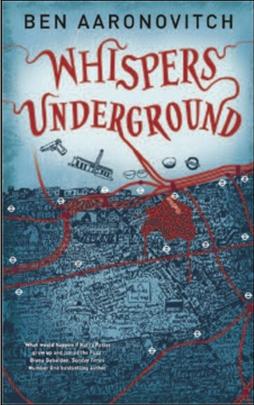
AMAZON BOOK REVIEWS: THE LONG EARTH by TERRY PRATCHETT/ STEVEN BAXTER and WHISPERS UNDERGROUND by BEN AARONOVITCH


4* Interesting idea

The idea of parallel earths is hardly original as it goes back at least ninety years in the history of Science Fiction to a story by Murray Leinster. Baxter and Pratchett do something a little different with it by firstly creating a potato-powered device which makes it easy to step into another world and secondly by having humanity non-existent in all of them but our own. Needless to say the two authors work well together and create a book which is different from either of their individual work but just as good. So don't go in expecting a Terry Pratchett story or you'll be disappointed.

It's highly readable and I could (have not other things got in the way) have read it in one session. There is so much potential in this scenario that it's inevitable the authors will end up surprising the reader as they take the story in unexpected directions. After finishing it I kept wanting to ask the authors about several things which occurred to me.

There's the (in)convenience that iron won't cross into another world with severe limiting effect (never mind that you can't take more than you can carry). This makes industrialisation exploitation very difficult. This is never explained but it suits the purposes of their story. Do they have a logical reason behind it?

The result of all this is that akin to a pioneering frontier type lifestyle similar to that of the colonisation of America only without the Native Americans. Some way into the story we learn that a fifth of the world's population have stepped over. Really? A fifth (or more -see a following point) of affluent societies have forgone their comfortable lifestyle to become pioneers. Sorry, but I for one like the creature comforts of a high tech society.

Also, while I know it's set a little way in the future and the device is relatively cheap. It would be difficult for those who would really need it to get their hands on it. I'm thinking of the majority of Africans who suffer from famine and oppression and lack of education. How could they get their hands on the electronics needed? Come to that, how could they get their hands on a potato?

None of this affects the story, it's just stuff that I thought of as a result of the story and doubtless there are numerous more implications or omissions to be found. This is actually another reason why you should buy this book -it makes you think. 


4* Is this man prolific or what?
 
This is the third book in the series in little over a year and shows no decline in quality. Instead, more secrets of London are revealed as seen through the eyes of Detective Constable Peter Grant (apprentice magician) our engaging narrator. This time, as the title suggests, the secrets are underground.

I started reading this around lunchtime and finished by early evening which tells you something about its readability. If you haven't read any of this series before, start with the first. But don't worry, it won't be long before you're reading this one. You won't be able to help yourself. Great fun series.

All right, Aaronovitch, when's the fourth one coming out you lazy sod?

Friday, 26 June 2009

HORROR: THE GENRE THAT ISN'T


1. Deconstructing horror.

Horror, as a the concept of a genre, didn't really exist until the late 30's when it became the term to describe a group of films. It's also a misleading term as it's highly inaccurate when applied to the films it purports to describe as, while they might be strange or bizarre, they are hardly horrific.

Of course genres appear all the time. Science Fiction didn't exist as a concept until the 1920's when Hugo Gernsback published Amazing Stories featuring tales of scienti-fiction. But the difference between SF and Horror is that science fiction had been emerging as a genre for some time, beginning with Marie Shelley's Frankenstein in the early 19th century, born out of the Industrial Revolution, Darwinism, and rapidly improving technology and its effects on society. It was a name given to an already existing genre of stories. By and large you can point to something, call it science fiction and generally be correct -always allowing for exceptions (see my entry on The Time Traveller's Wife). Similarly, fantasy.

Horror was a commercial label applied to a group of movies. Once horror existed as a concept for a genre it became natural to look for anything already existing which seemed to fit and stamp the label on it. Ask anyone these days to name a horror writer and they'll say Stephen King, or if they happen to be a little bit knowledgable, H.P. Lovecraft.

Except Lovecraft didn't write horror -he wrote supernatural thrillers or 'romances'. That isn't romance in today's sense but fiction that is elevated somehow out of the norm. Wells' early novels were scientific romances. H Rider Haggard's adventure novels with their elements of SF and magic were also 'romances'. And, although Stephen King is considered a horror novelist, much of his work is Science Fiction. Like my own novel, King uses an SF trope as a metaphor for teenage alienation in Carrie, which is not a horror novel. Neither is The Stand -apocalyptic fantasy with SF elements. It, when the secrets are revealed, is itself revealed as SF.

Let's look at movies which have been claimed for horror but aren't. Alien is pure SF and is inspired by an A.E. van Vogt story from the 50's and the movie It (no relation to S.King). The Silence of the Lambs is essentially crime being about a serial killer. There are countless other examples out there.

Horror is an awful term which is slapped on novels and movies as a commercial label but to their critical detriment. Because of this a popular new subgenre has taken on the term 'paranormal romances' in order to disassociate itself from being tarred with Horror brush. We're talking Laurell Hamilton and her ilk. Unfortunately this new name is awful and also misleading. Paranormal, to me at least, has connotations of SF, Romance (used in the traditional sense is, ironically, accurate but in fact) evokes Mills & Boon, and indicates that the book is aimed at women. While this point may be primarily true, many men, including me, enjoy this type of novel. Jim Butcher's Harry Dresden series is a male equivalent of Anita Blake. But what they are are supernatural thrillers (or 'romances' in the traditional sense,) as are Dracula, Dennis Wheatley's classic The Devil Rides Out, and many more.

But what these stories really are, in fact, are part of a sub-genre of contemporary fantasy. Fantasy itself has become tarnished with the brush of Tolkein's Lord of the Rings, when in fact the genre is infinitely wider than that. Most of the novels and movies labelled as horror are, if not a crime variant or SF, are fantasy or part of a sub-genre of fantasy. Stephen King's The Shining is a ghost story, a sub-genre with its own long history.

Fantasy itself evolved out of, among others, creation myths (see Genesis for one example) and folk tales (the brothers Grimm for another) and, therefore, has a history as old as the human race. Interestingly, SF did not evolve out of fantasy but, as I pointed out earlier, from the impact of science (which may have predated the Industrial Revolution but, as a concept, not by much) and technology on culture.

I could go on adding examples to emphasise my point but I think it's already proven.

Horror, as a genre, does not exist.

So why do I love horror movies so much?

2. Reconstructing Horror.

By and large and when it comes to books, I stand by what I've just written. When it comes to movies, however, well, that's a different matter. It would be ludicrous to assert that Horror Movies don't exist. Of course they do, there just aren't as many as people believe.

They have become a genre. Of course now I have to define exactly what I mean by a horror movie. What does a movie have to possess to be defined as horror (though it can still be defined as something else as well)?

Essentially, it's the frisson. Or, to put it more crudely, the money shot -I hate that phrase because for some reason I associate it with porn (and, no, I'm not remotely a porn hound). A horror movie is created to provide the frisson and/or the money shot. Note that I'm using the singular but the plural is implied as horror movies usually have several of them.

The frisson is the thrill. The moment in the movie, and it may or may not contain overt horror, when the film maker gets the audience to jump out of their seats (hopefully) -the head in the boat in Jaws. The money shot is horror when the audience places their hands over their collective mouths in mock shock and disgust -just about any scene in Tokyo Gore Police which, even though it's undeniably SF, is inarguably horror and horrific in the extreme (see my review on Amazon) as its sole raison d'etre is to shock.

The whole point of the horror movie is scenes like this. They may well have a subtext like Night of the Living Dead but they are undeniably created to be Horror. They want to shock their audiences and if they don't they have failed.

Equally there are horror novels; here the sole point is to get from one gruesome scene to the next. James Herbert started out as a horror writer (The Rats) but as he gained in skill and experience he moved iaway from gore for the sake of it and into contemporary fantasy such as ghost stories.

And that, pretty much, is that. Horror is, with a few exceptions, a misleading label for many movies that are considered as such and completely misleading for most so-called horror novels. I'd like to apply the concept of contemporary fantasy more rigorously as well as the use of more accurate sub-genre terminology such as the 'supernatural thriller', and for sanity's sake, get rid of the paranormal romance.

Post Script.

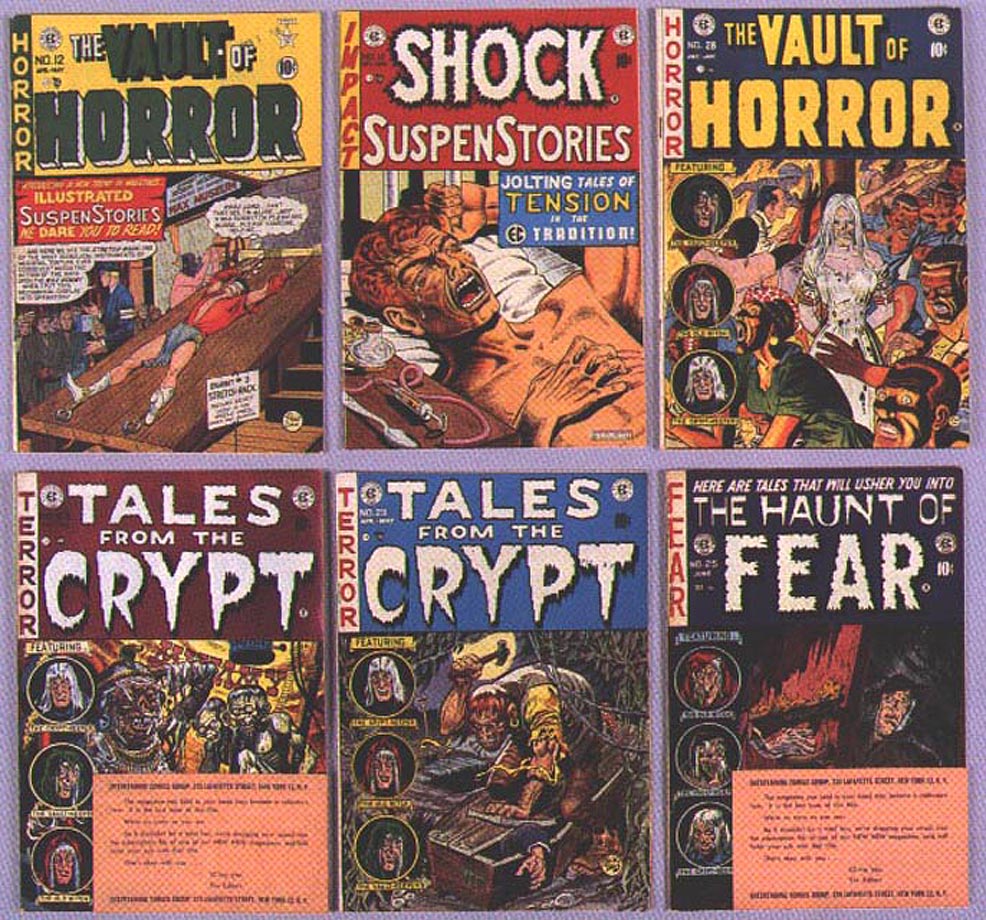
Now, as for horror comics....