Or, to give this post its correct title-
A BRIEF LOOK AT DC COMICS CONTINUITY, DISGUISED AS A REVIEW OF ‘SHOWCASE PRESENTS ALL STAR COMICS’, TO FUNCTION AS A PROLOGUE TO THE DCnU (DC NEW UNIVERSE).
After a gap of about 8 years, I started reading comics again after being introduced to Roy Thomas and Barry (before Windsor) Smith’ version of Robert E. Howard’s Conan the Barbarian published by Marvel (the collected editions from Dark Horse are reviewed elsewhere in this blog). From then I became, I suppose, a bit of a Marvel zombie. I did pick up the occasional DC title but mostly, apart from Wein & Wrightson’s amazing Swamp Thing, DC hadn’t woken up to smell the coffee –their titles just didn’t have the vibrancy of Marvel’s. But they got better and eventually my consumption of DC titles increased as Marvel’s decreased. DC just had better characters and once the Moore-led British invasion got underway, they were beat Marvel (with rare exceptions like Miller’s Daredevil) hands down.

Feeling a bit nostalgic, I recently picked up Jack Kirby’s Kamandi (see recent review) which in turn got me checking out cheap DC reprints. Their Showcase Presents series collects massive (usually over 500 pages) older titles from the 60’s and 70’s but in black and white, not colour. All Star Comics is one of several I either ordered or am thinking about. The reason I opted for this title is because I’m fond of parallel worlds stories.
Now what is considered the ‘Silver Age’ of comics began in the 50’s with DCs revival of super heroes, creating new characters with older names. The new Flash, was I believe, the first and the original Flash, from whom he took his name was a character from a comic in his world. Until, in one of the most influential comic stories ever, The Flash of Two Worlds, he meets the original Flash who lives in a parallel world (known as Earth 2) which contains all the old characters from DCs initial foray into superheroes which began with Batman and Superman in 1939 which marks the start of the 'Golden Age'.
DC gradually began to reintroduce the Golden Age characters into what became known as the DC Universe, most notably in team-ups of the JLA (Justice League of America) and the JSA (Justice Society of America) their older counterparts. Anyway, in 1976 DC revived their old title, continuing the numbering, adding Presents The Super Squad and, in smaller lettering, Featuring The Justice Society of America. The hideously named Super Squad consisted of Power Girl (Earth 2's less powerful version of Supergirl and an ugly feminist chip on shoulder whereby she constantly has to demonstrate how much better than men she is), Robin (who as a bulked up Dick Grayson is US ambassador to an apartheit-free South Africa) and the Star-spangled Kid who is twenty years out of his own time and feels it. A few issues after Paul Levitz took over the scripting from Gerry Conway, the title lost the Super Squad and it became the Justice Society of America, as it always should have been.
The title lasted four years from the beginning of 1976 to the end of the decade and while, it was mostly conventional super-hero stuff, it did have some fun stuff for DC fans. Bruce Wayne has stopped being the Batman following the death of his wife Catwoman and become Commisioner Wayne. Later in the series, his daughter The Huntress joins the JSA. A grey-haired Superman is still around but spends most of his time as Clark Kent managing editor of the Metropolis newspaper The Daily Star(!). The art, mostly by Joe Staton, is more than adequate, but of more interesting is a number of early issues inked and, in a few cases, pencilled, by the wonderful Wally Wood.
I have to say that I do miss the colour.
Roy Thomas was later to create Infinity Inc, featuring the sons and daughters of the JSA, which basically did the job that the Super Squad was supposed to do only a hundred times better. Sadly, towards the end of series, DC made a disastrous decision.
______________________________________________________________________
Yes, I have to draw a line under it.
DC decided that their multiple worlds was too confusing for readers, especially new readers. It's important to note that there were many parallel worlds other than Earth 2. The Marvel Family lived on Earth-S (S for Shazam). Back in the day Fawcett publishers came out with Captain Marvel which DC decided was a copy of Superman (he wasn't), sued, won, bought out Fawcett and eventually began publishing their own version which, for legal reasons couldn't use the character's name in the title so Shazam was used instead. These days the all-powerful hero is now regarded as an archetype and Superman has dozens of clones. Even Alan Moore paid homage to him in Supreme.
DC also bought up the Charlton characters (Blue Beetle, The Question, etc) and gave them their own universe. In their own world The Crime Syndicate (an evil JLA) lived and ruled. In another one the Nazis had won and were fought by The Ray, among others.
But enough, said DC. Let's simplify all this. Let's just have one universe where all the characters live except the ones we can kill off for publicity purposes. And so they hired Marv Wolfman to write and George Perez to pencil the first and greatest of all the company-wide crossovers ever -Crisis On Infinite Earths- a 12 issue series which would cross over with every other single DC title. It is inarguably (which, unlike 'arguably', means I'm right so don't contradict me) a superb super-hero story with terrific art. And it did exactly what it was supposed to do which was to rebuild the DC Universe from the ground up. The result was one universe and one universe only -no parallel worlds, only one Superman. Captain Marvel and Superman lived on the same Earth.

Unfortunately the powers that be at DC hadn't thought it through well enough and the next 25 years were packed with crossover series which attempted to fix the inconsistencies and mistakes which came out of Crisis -Zero Hour, Infinite Crisis, Final Crisis, etc. Parallel worlds were reintroduced in the actually excellent weekly series 52.
But none of it really worked and so DC threw up its collective hands and said, Let's start again from scratch.
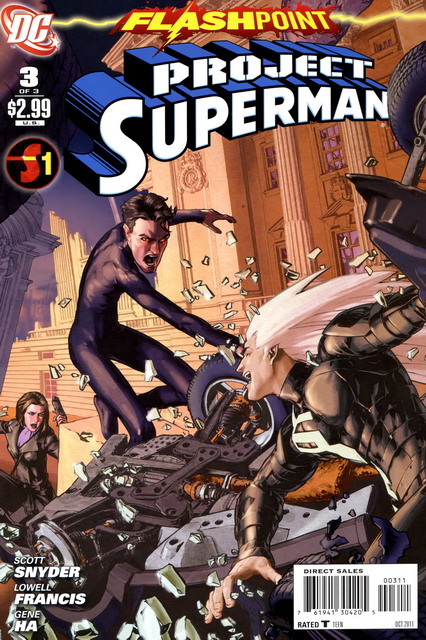
And thus came the Flashpoint miniseries and its spin-off titles.
And at the end of that, every single title was cancelled and a new DC Universe was born with every title starting at issue 1.
I'm not going to go into more detail, though I want to. I'll be reading the collected Flashpoint in a few days. I have on order, though it won't arrive till mid-January, a hardback collection containing all the 52 first issues from the DCnU. The individual title collections (of which I'll be buying a few) probably won't be arriving until May at the earliest.
To be continued.