Showing posts with label graphic novel review. Show all posts

Friday, 31 August 2012

GRAPHIC NOVEL REVIEW: O.M.A.C. vol.1 OMACTIVATE!

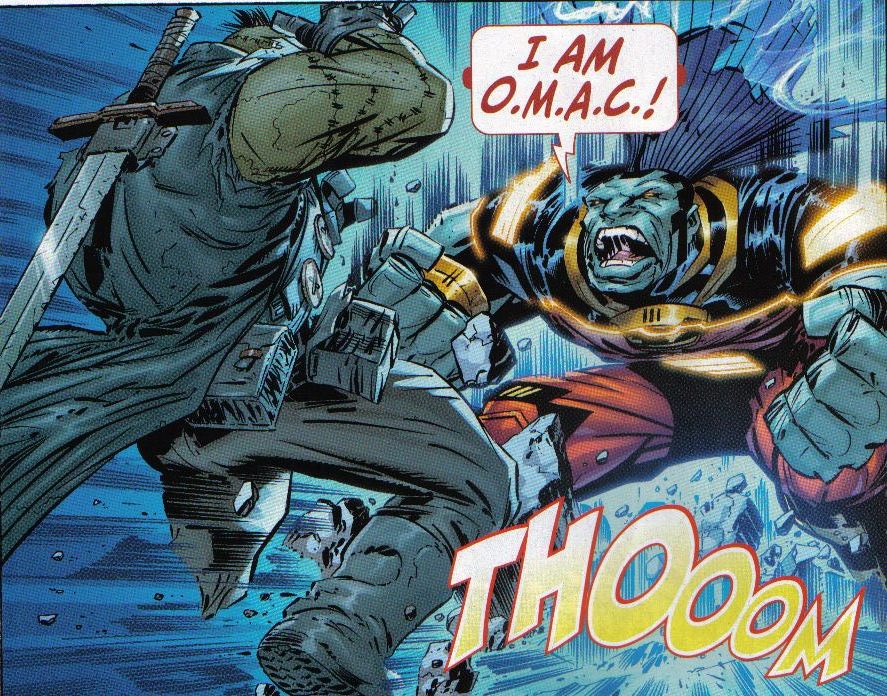
There's nothing subtle about this re-working of the Jack Kirby character whose name stood for One Man Army Corp but is now in, DC's New 52, One-Machine Army Construct in the hands of Dan Didio (DC head honcho) who co-scripts with artist Keith Giffen. Giffen's art channels Jack Kirby to perfection while remaining clearly Giffen's own. Matching the art, the script also echoes Kirby's massive sound and thunder in a completely unsubtle assult on the reader and it's just great.

Didio and Giffen have done an excellent job of transforming elements of Kirby's work for DC in the 70's into a new form. Originally OMAC was just a tough enhanced human with a Mohawk haircut. Now he's something closer to a human monster with the Mohawk transformed into some kind of energy field. Utilising the body of Asian-American Kevin Kho, the enigmatic Brother Eye controls the monstrous OMAC into attacking the enigmatic scientific research institute Cadmus (itself secretly funded by the Checkmate organisation under the leadership of the ruthless Maxwell Lord). This brings OMAC into conflict with a variety of supervillains (at least one from Apocalips), monsters, and heroes (the latter including Frankenstein and a certain Kryptonian) and meeting a few characters who once appeared in Kamandi.

Fans of Jack Kirby will be squeeing in their seats and I couldn't blame them. This is a massive explosion of comic book energy which still manages to find space for some sly humour.

Disappointingly, the comic was cancelled after the eight issues included here so, for the time being, OMAC is de-omactivated. At least it ends in a satisfying manner and I'm sure the character will return somewhere.


Monday, 27 August 2012

GRAPHIC NOVEL: ACTION COMICS VOL 1 SUPERMAN AND THE MEN OF STEEL


The Unmissable Action Adventures of Young Superman: a slightly edited Amazon 5* review.

Of all DC's New 52 titles, this, after reading the first issue in that massive collection of all first issues, was the collected edition I'd been most looking forward to. I mean, it's written by Grant Morrison who wrote the best ever Superman series in All-Star Superman which is recommendation enough alone. This is the story of how the young (around 22 years old) Superman became SUPERMAN.

Set five years earlier than the rest of the New 52 continuity, superheroes are just beginning to emerge and we come across a Superman whose only been around a few months. He's lacks a proper costume -just ordinary workman's boots, jeans, t-shirt with logo, and a cape- and he has it in for corrupt capitalists. This a Superman for ordinary people. He's brash, confident and cocky and having a great time getting up the collective nose of authority and Lex Luthor has been hired to bring him down. When he first appeared, bullets bounced off him; now he can, just, withstand shells from a tank. He can leap tall buildings and his maximum speed is about 600mph. All this is about to change.

Meanwhile, young Clark Kent is a low-paid, sloppily-dressed crusading journalist, working for a dying small-circulation Metropolis paper, who lives in a cheap apartment, and is best friends with Lois Lane's pet photog, Jim Olsen. Perry White wants him for the Daily Planet but he won't go because he believes his integrity would be compromised. He's also getting secret information about a corrupt capitalist from an unknown source.

When Superman is captured after Lex Luthor has had him hit by a train which knocks him unconscious, he's tested in a secret government lab overseen by Lois Lane's father and where government scientist John Henry Irons is working on a super-suit. Irons gets angry when he discovers Luthor torturing the prisoner and about then everything explodes. Which is where I'll stop with the plot summary as I don't want to spoil it for you.

This is terrific stuff. Great dialogue and a nifty plot from Morrison which reinvents the character while remaining faithful to his origins. Terrific dynamic art from Rags Morales which threatens to burst out of the page; plus some inventive Krypton sequences courtesy of Gene Ha. There are four backup stories by Sholly (who?) Fisch which are okay. Toss in all the variant covers, and a nice piece in which Morrison and Morales write about the art and story to complete the package.

If you're only slightly into DC comics, this one is essential.


Friday, 20 July 2012

GRAPHIC NOVEL REVIEW: CREEPY PRESENTS RICHARD CORBEN

This review (minus illustrations) will be submitted to Amazon shortly.

As you can tell from the book's subtitle this isn't a graphic novel but a collection of short graphic stories from two 'adult' and primarily b/w horror magazines (not comics) mostly in the 70's and a big fat collection it is too.

Corben really came to fame with his adult fantasy series Neverwhere (aka Den) which started in the French magazine Metal Hurlant (later US edition, Heavy Metal). A puny human was transported into a magical world and into the body of hairless, mostly naked,  (censored censored) muscleman and hero Den. Den fights lots of vile monsters, evil sorcerors, beautiful evil naked women with (censored censored) who wanted to (censored censored censored) and then kill him, rescues beautiful naked heroines with (censored censored) and has (censored censored censored) and adventures. Definitely adult fantasy.

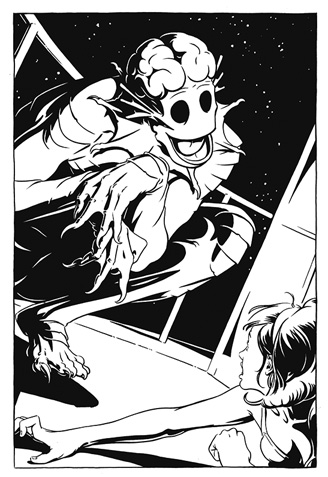
If you're easily offended by (censored censored) don't look at the image below. The one after is more acceptable.
But back to the book in hand.

The short story is a form that's fallen out of favour in comics since the rise of the extended multi-issue narrative begun primarily by Stan Lee at Marvel back in the 60's. It isn't surprising as, in comics and particularly horror comics, the story is usually very simplistic and dependent on a gimmick or money shot shock end (the legendary EC is excepted from the simplistic tag but only just). It's simply very difficult indeed to create something worthwhile in standalone short form graphic narrative. The form has only begun to gain respectability due to independent creators like the Hernandez Brothers who sometimes use it for a different and more serious purpose.

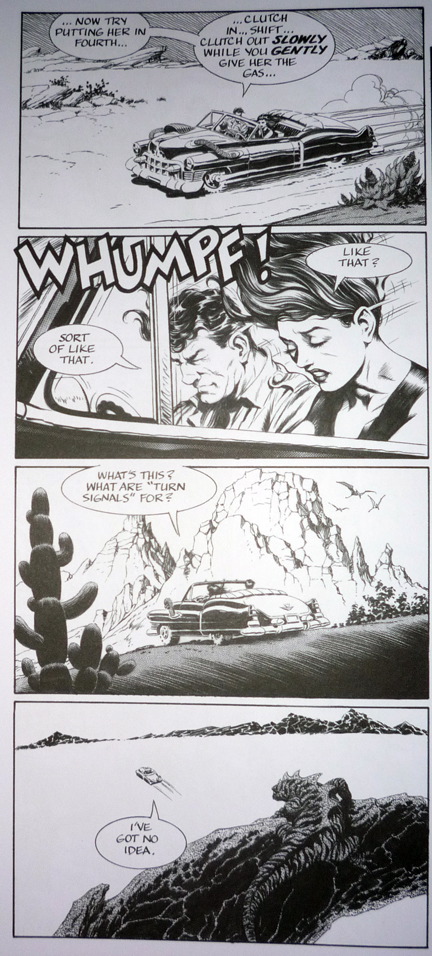
To be honest, the Warren magazines weren't always notably better than their antecedents, though the art was a vast improvement (again EC mostly excepted) from the horror comics of the 50's. Now, in their heyday of the 70's, Creepy and Eerie had people like Jeff Jones, Berni Wrightson (the subject of his own Creepy collection and reviewed elsewhere), a variety of talented (but cheap) Philippino artists (Alcala, Maroto, etc), and, of course, Richard Corben who was present throughout that period. The art is usually way better and more sophisticated than the stories they illustrate though that doesn't mean the stories are lacking in interest. But basically you'd best be here for the art rather than the narrative, though there are gems like his adaptation of Poe's The Raven.


The stories are presented in chronological order of appearance (which isn't always the order in which they were drawn) so you can see the development of Corben over a decade. There's a wide range of genres and subgenres: horror, SF, crime, serial killer, ghost, fantasy, monster, humour, satire, etc and all are short enough so that you never get bored. A substantial minority are in colour and coloured by Corben himself who was an innovator in its use. At over 340 pages (including covers and sketches) it can justifiably call itself a definitive collection. Publisher Dark Horse could easily have split it into two volumes and it's to their credit that they didn't. Plus there is a very good introduction by Jose Villarrubia.

For what it is, this is a truly excellent collection and fans of the artist will be ecstatic when they see it. Now if only someone would repackage Corben's longer form stories like Den, Mutant World, Bloodstar and Arabian Nights, I'd be happy as a  censored censored censored.


Friday, 30 December 2011

GRAPHIC NOVEL: DC THE NEW 52 (DC, 2011)


Take a deep breath and hold on to your seats because we’ve got a long wild ride ahead into one of the boldest decisions ever taken by a comics publisher and into 1200 pages of comics.

The superhero genre of comics is often derided by critics as inferior to more ‘mature’ or ‘serious’ works of graphic storytelling; though I suspect that literary snobbery is aimed as much at the fans whom these critics see as reading nothing else which, pretty much like most generalisations, both is and isn’t true. I have a broad taste in comics or graphic novels or whatever it is you want to call them but I still keep coming back to superheroes. Why? Because they’re just so much damn fun which is why they’ve not only lasted but come to be the most popular genre of comics. This massive book demonstrates why that is so.

But it was still a big gamble for publishers DC Comics. They cancelled all their titles and rebooted their shared universe from scratch with 52 No.1’s.  And, in my opinion, they were extremely clever in the way they went about it. This new universe begins five years after the appearance of superheroes which allows some stories which worked well and were popular from the previous continuity to be carried on (specifically titles which feature Batman) and to adapt elements from it to makes changes to characters (Barbara Gordon was crippled by the Joker but has now recovered and is back as Batgirl). Vertigo (DC’s mature readers imprint) characters which were owned by DC (Swamp Thing, Animal Man, John Constantine, etc) have been brought into the new shared superhero universe. Elements of the Wildstorm imprint bought by DC years ago and previously in their own separate universe are now integrated into DC’s –Stormwatch, Grifter, Voodoo. Some defunct characters have been revitalised (Resurrection Man – a favourite of mine from the 90’s- I,Vampire, Omac). And there are a handful of new titles –Justice League Dark, Frankenstein Agent of Shade, and Demon Knights.

DC planned this as a jumping on point, though no doubt being well aware that for others, like a long-standing DC superhero fan and friend of mine, it could also be a jumping-off point. No doubt some did indeed jump off but many more jumped on. For the first time in decades, DC outsold Marvel Comics and while sales have dropped after the initial explosion, DC are still matching Marvel. So as a commercial exercise, there’s no question that DC’s New Universe has been a significant success. 

But has it also been a creative one?

Well, having just read all 52 first issues and read hundreds of reviews on various websites of these and successive issues, the answer to that is a qualified yes. So, time to look at the book itself.

Although it begins with the first title of the New Universe published, it doesn’t reprint them in order of publication. Instead, they are arranged into categories. The first section is Justice League and does indeed begin with that title, setting it five years before the new current continuity when superheroes are just beginning to (re?)emerge. And concerns Green Lantern (Hal Jordan) meeting Batman, for the first time, in Gotham against a mutual alien enemy. It ends up in Metropolis where GL gets the crap knocked out of him by –oh come on; I don’t really have to tell you by whom. So these first few issues of JL are the origins of the current team. Next up is the founding of Justice League International in the ‘present’ day. Other titles in this section include Aquaman, Wonder Woman (superb), The Flash, Green Arrow (more in line with the character as shown in the tv series Smallville), The Savage Hawkman, etc. You might do a double-take when you see Mister Terrific in there. This is the first case in the book of DC shoehorning in a title which doesn’t fit anywhere else; unless there’s something they aren’t telling us. 

The next section consists of four titles, one of them being the section title Superman, but it’s preceded by the Grant Morrison written Action Comics which is chronologically the earliest title and features Superman at the beginning of his career when his powers are limited (he can only leap buildings at a single bound, etc), he doesn’t have a proper costume as such, and he’s after crooked  businessmen which puts him in line with the Siegel and Schuster original character. And it’s wonderful. In the George Perez scripted Superman, he’s in his new costume (no pants on top). The other titles are Superboy and Supergirl who seem to be newish takes on these characters.

The 11 titles of the Batman section are often the least changed yet the most startling. The final page at the end of Detective Comics is both surprising and deeply shocking and is guaranteed to get you to buy the next issue. Catwoman is already almost a legend for its graphic depiction of rough costumed sex between her and Batman. I’ve already mentioned the new/old Batgirl. There are also the usual suspects –Nightwing and Birds of Prey. Two new titles are Batwing (an African Batman) and Red Hood & the Outlaws which stars Jason Todd, Roy Harper, and a rather controversial version of Starfire. And then there’s Batwoman (which was delayed for months so as to fit in with the DCnU) which is in a league of its own. If you only buy one title, this is it.

I’ll skip the four Green Lantern titles of which only The New Guardians caught my interest and move quickly on to The Dark which happens to be the most interesting and diverse collection of titles which all happen to be generally pretty good or better. They also share something else in common, apart from the fact they appear to involve the supernatural, in that they are all setup issues introducing the reader to the characters. Justice League Dark features Madam Xanadu trying to form –oh you guessed- which includes, among others, John Constantine and the Enchantress. Animal Man and Swamp Thing have already garnered high praise. I, Vampire is probably the most surprising title to be revived and is about vampires surviving in a world of superheroes. Resurrection Man is the title I would have second least expected to be revived but the one which most delighted me. Demon Knights (written by Paul Cornell) is either Justice League Medieval or an earlier version of Stormwatch (see above). Add Frankenstein/Shade and that’s 7 trades I’ll be buying when they come out.

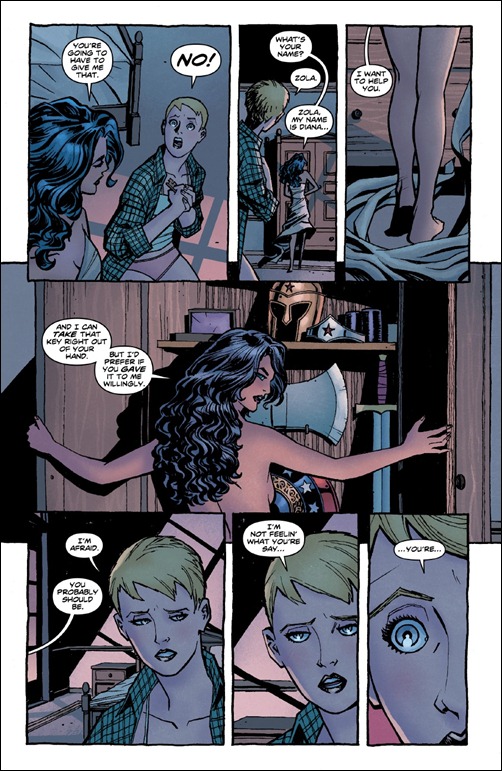
Less interesting, but not without interest, is The Edge a disparate collection of titles bunged together to call them something. There’s the Wildstorm titles (see above), Deathstroke and The Suicide Squad (same old, same old), Blackhawks (a completely new team of covert operatives), and Men of War (the grandson of an old DC character). But I’ve saved the best till last. Dan Didio and Keith Giffen channel the spirit of Jack Kirby in a new over the top version of his character O.M.A.C whose Mohawk hairdo is now an energy field of some kind. In All-Star Western, Jonah Hex has been hired to investigate the Ripper-like murders of prostitutes in Gotham City and finds himself way over his head in one of the best of the New 52 titles.

 And finally, Young Justice starring the younger heroes though what Hawk & Dove are doing there I’ve no idea. There’s a nice reboot of the Jaime Reyes incarnation of the Blue Beetle which is welcome and a very promising Teen Titans. Static Shock mildly disappoints and neither of the two Legion of Superheroes titles impress.

And there we have it. It’s a mixed bag which ranges from the nothing special to the WOW! with an average of pretty good. Or, if you want it graded numerically: 3.75, 9.5, 7.5 respectively. (Except for Batwoman which rates a 10).
I’ve been going through the list of titles and, based on the first issues, I will definitely be buying 20 of the titles in trade editions when they appear, with another 10 as strong possibilities depending on reviews. This alone has made it worth me buying this book as that’s a lot higher number of DC trades than I have been getting. Additional material like alternate covers is minimal and could have been a lot more. 

Sure, it’s also quite expensive but just remember you’re getting a 1200 page 52-comic hardback sampler of some of the best superhero comics around and you’re in at the ground floor of the DC New Universe. For superhero fans that’s as good as it gets.


This review has also been published on amazon.co.uk and amazon.com

Tuesday, 27 December 2011

GRAPHIC NOVEL: DEAR CREATURE by JONATHAN CASE (TOR, 2011)

So, there's this vaguely humanoid sea creature which lives in a sunken submarine in a Californian bay where it snacks on the remains of dead submariners which it shares with its friends the crabs. Now and again it is compelled by drifting pheromones to head to shore to kill and eat sexually aroused teenagers.

This is Grue, our hero. Now both confusing and stimulating him are the bottles containing pages of Shakespeare which keep appearing in the waters of the bay. Entranced by Shakespeare's language, Grue has begun to speak in iambic pentameter, an affectation that is derided by his friends the crabs who are more interested the scraps of human remains he leaves for them.

A chain of events occur which (I won't detail here) lead him to discovering where the bottles containing fragments on Shakespeare come from, how his actions impact on a human family, and him falling in love with a middle-aged female agoraphobic.

And now, here's the cover.
This really is almost impossible to describe. A plethora of adjectives spring to mind: graceful, witty, tragic, deft, bold -which are all appropriate but don't convey the full flavour. The artwork is delightful with its human figures reminiscent of Dave Stevens and Terry Moore. The art is also in black and white, not only devoid of colour but also of grey; there is no shading at all which is unusual but it works. This is really quite a unique and delightful graphic novel.

Wednesday, 30 November 2011

GRAPHIC NOVEL: FLASHPOINT (DC, 2011)


DC New Universe: Prologue 2.

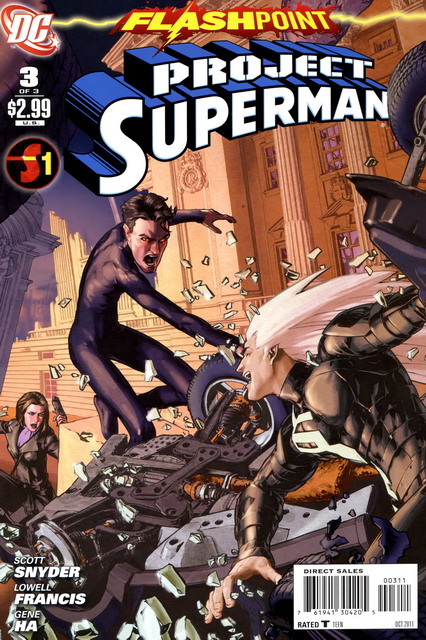
When I post an edited version of this review on Amazon I'll be giving it four stars. The graphic novel itself comprises the original 5-issue miniseries, alternate covers, plus a variety of character sketches, with a wraparound image on the book itself which is revealed when you remove the jacket. 

The story is quite well done, albeit somewhat compressed. Scenes, sometimes even single panels, refer to events which take place in the range of single issues and three-part miniseries which surround the core narrative. I wasn't actually going to bother with any of these others when they're collected  except for the Superman tie-in (I'll explain why later), but now, having actually read the whole core story, I find myself interested enough to buy several of the others.

The artwork is good slick stuff by Andy Kubert (one of two comic artist sons of comic artist legend Joe Kubert) in a stylish quasi-realistic super-hero mode being attractive, dynamic and detailed.

Now the story. Barry Allen/The Flash wakes up in a changed world where he isn't the Flash, Batman isn't Bruce Wayne but is prone to kill criminals, Hal Jordan is still a test-pilot, no-one has heard of Superman and the world's great and most trusted super-hero is Cyborg. This, on its own, isn't too bad but, as Barry discovers, things are far worse. Aquaman and his kingdom Atlantis has drowned western Europe and is at war with Wonder Woman  (who killed Aquaman's wife) and her Amazons who have conquered the UK, killed millions and castrated male survivors. This war threatens to destroy the world unless the superheroes can band together to stop them. The problem with this is that most super-heroes hate each other.

As I said above, there's an awful lot going so I can't really go into detail without going on for ages. Just one subplot though: Superman does exist but he's been locked in a secret vault since he arrived on this planet as a baby is isn't the Superman we know. Needless to say, Barry Allen, with his powers returned, faces his arch-enemy who has caused the reality shift and hurtles back in time to get things back on their proper track. Which is when something strange happens. Exactly what, we won't find out until the DC New Universe comics trades are released, though of course we already know (or I get my hands on a copy of the collected 52 first issues in mid-January).

Take away all the reasons behind it and we're still left with a good full of surprises super-hero yarn and that's just fine by me.


More images can be found on Google where, of course, I got these from.

Thursday, 24 November 2011

GRAPHIC NOVEL: SHOWCASE PRESENTS ALL STAR COMICS


Or, to give this post its correct title-
A BRIEF LOOK AT DC COMICS CONTINUITY, DISGUISED AS A REVIEW OF ‘SHOWCASE PRESENTS ALL STAR COMICS’, TO FUNCTION AS A PROLOGUE TO THE DCnU (DC NEW UNIVERSE).

After a gap of about 8 years, I started reading comics again after being introduced to Roy Thomas and Barry (before Windsor) Smith’ version of Robert E. Howard’s Conan the Barbarian published by Marvel (the collected editions from Dark Horse are reviewed elsewhere in this blog). From then I became, I suppose, a bit of a Marvel zombie. I did pick up the occasional DC title but mostly, apart from Wein & Wrightson’s amazing Swamp Thing, DC hadn’t woken up to smell the coffee –their titles just didn’t have the vibrancy of Marvel’s. But they got better and eventually my consumption of DC titles increased as Marvel’s decreased. DC just had better characters and once the Moore-led British invasion got underway, they were beat Marvel (with rare exceptions like Miller’s Daredevil) hands down.

Feeling a bit nostalgic, I recently picked up Jack Kirby’s Kamandi (see recent review) which in turn got me checking out cheap DC reprints. Their Showcase Presents series collects massive (usually over 500 pages) older titles from the 60’s and 70’s but in black and white, not colour. All Star Comics is one of several I either ordered or am thinking about. The reason I opted for this title is because I’m fond of parallel worlds stories.

Now what is considered the ‘Silver Age’ of comics began in the 50’s with DCs revival of super heroes, creating new characters with older names. The new Flash, was I believe, the first and the original Flash, from whom he took his name was a character from a comic in his world. Until, in one of the most influential comic stories ever, The Flash of Two Worlds, he meets the original Flash who lives in a parallel world (known as Earth 2) which contains all the old characters from DCs initial foray into superheroes which began with Batman and Superman in 1939 which marks the start of the 'Golden Age'.

DC gradually began to reintroduce the Golden Age characters into what became known as the DC Universe, most notably in team-ups of the JLA (Justice League of America) and the JSA (Justice Society of America) their older counterparts. Anyway, in 1976 DC revived their old title, continuing the numbering, adding Presents The Super Squad and, in smaller lettering, Featuring The Justice Society of America. The hideously named Super Squad consisted of Power Girl (Earth 2's less powerful version of Supergirl and an ugly feminist chip on shoulder whereby she constantly has to demonstrate how much better than men she is), Robin (who as a bulked up Dick Grayson is US ambassador to an apartheit-free South Africa) and the Star-spangled Kid who is twenty years out of his own time and feels it. A few issues after Paul Levitz took over the scripting from Gerry Conway, the title lost the Super Squad and it became the Justice Society of America, as it always should have been.

The title lasted four years from the beginning of 1976 to the end of the decade and while, it was mostly conventional super-hero stuff, it did have some fun stuff for DC fans. Bruce Wayne has stopped being the Batman following the death of his wife Catwoman and become Commisioner Wayne. Later in the series, his daughter The Huntress joins the JSA. A grey-haired Superman is still around but spends most of his time as Clark Kent managing editor of the Metropolis newspaper The Daily Star(!). The art, mostly by Joe Staton, is more than adequate, but of more interesting is a number of early issues inked and, in a few cases, pencilled, by the wonderful Wally Wood.

I have to say that I do miss the colour.

Roy Thomas was later to create Infinity Inc, featuring the sons and daughters of the JSA, which basically did the job that the Super Squad was supposed to do only a hundred times better. Sadly, towards the end of series, DC made a disastrous decision.

______________________________________________________________________
Yes, I have to draw a line under it.


DC decided that their multiple worlds was too confusing for readers, especially new readers. It's important to note that there were many parallel worlds other than Earth 2. The Marvel Family lived on Earth-S (S for Shazam). Back in the day Fawcett publishers came out with Captain Marvel which DC decided was a copy of Superman (he wasn't), sued, won, bought out Fawcett and eventually began publishing their own version which, for legal reasons couldn't use the character's name in the title so Shazam was used instead. These days the all-powerful hero is now regarded as an archetype and Superman has dozens of clones. Even Alan Moore paid homage to him in Supreme. 

DC also bought up the Charlton characters (Blue Beetle, The Question, etc) and gave them their own universe. In their own world The Crime Syndicate (an evil JLA) lived and ruled. In another one the Nazis had won and were fought by The Ray, among others.

But enough, said DC. Let's simplify all this. Let's just have one universe where all the characters live except the ones we can kill off for publicity purposes. And so they hired Marv Wolfman to write and George Perez to pencil the first and greatest of all the company-wide crossovers ever -Crisis On Infinite Earths- a 12 issue series which would cross over with every other single DC title. It is inarguably (which, unlike 'arguably', means I'm right so don't contradict me) a superb super-hero story with terrific art. And it did exactly what it was supposed to do which was to rebuild the DC Universe from the ground up. The result was one universe and one universe only -no parallel worlds, only one Superman. Captain Marvel and Superman lived on the same Earth.


Unfortunately the powers that be at DC hadn't thought it through well enough and the next 25 years were packed with crossover series which attempted to fix the inconsistencies and mistakes which came out of Crisis -Zero Hour, Infinite Crisis, Final Crisis, etc. Parallel worlds were reintroduced in the actually excellent weekly series 52.


But none of it really worked and so DC threw up its collective hands and said, Let's start again from scratch.

And thus came the Flashpoint miniseries and its spin-off titles. 

And at the end of that, every single title was cancelled and a new DC Universe was born with every title starting at issue 1.

I'm not going to go into more detail, though I want to. I'll be reading the collected Flashpoint in a few days. I have on order, though it won't arrive till mid-January, a hardback collection containing all the 52 first issues from the DCnU. The individual title collections (of which I'll be buying a few) probably won't be arriving until May at the earliest.
To be continued.
Thursday, 17 November 2011

GRAPHIC NOVEL: OSAMU TEZUKA'S PRINCESS KNIGHT VOL.1 (VERTICAL, 2011)


Osamu Tezuka is one of the greats of graphic storytelling. Not to have read anything by him is akin to not having read anything by Stan Lee & Jack Kirby, Alan Moore, Moebius, Jaime & Gilbert Hernandez, Will Eisner, Frank Miller, etc. Tezuka makes you see the form in a completely new way just as Akira Kurosawa (film), Hayao Miyazaki (animation) and Haruki Murakami (contemporary fiction) do. He is that important.

Tezuka (1928-1989) was an astonishingly prolific writer/artist. His dying words were, apparently, “I beg you, let me work.” He died aged 61, still at the height of his powers, but leaving a vast legacy behind. Although known at the time only as a cult figure to western audiences, he was honoured in Japan where he was accorded the nickname “The God of Manga” for his influence on and contribution to this uniquely Japanese form of graphic storytelling.

His work is enormous in scope ranging from fairly simple children’s adventures to his dark adult-orientated work of the 1970’s, not forgetting his masterpiece, the playfully philosophical multi-volume series Buddha.  But for all the range of work , it is always recognisable as that of the same person. Even in his children’s books there is an underlying compassion, open-mindedness, and empathy for humanity and all our foibles. Even his most famous creation, the exhuberant series of adventures about the child-robot Astro Boy (aka Mighty Atom), is a parable about racism. Yet Tezuka never openly preaches, he lays down his work for the reader to take away what they will.
Note: the book itself is black & white

Which brings me, finally, to Princess Knight, an early work originally published in serial form 1953-56 and then revised and republished 1963-66. Vertical, the publisher who has, and still is, re-issuing many of Tezuka’s finest works state on the blurb that “Princess Knight mixes themes of gender identity and politics with classic shojo-style illustration to create a charming proto-feminist masterpiece…” Wow! Now while this is actually true, it doesn’t make it doesn’t exactly make it sound suitable for children. In fact this is an all-ages fantasy , originally aimed at children (particularly girls) but does possess a certain charm for the older reader.  Vertical, however, are clearly aiming this at an adult audience.

Accidentally given a boy’s heart as well as a girl as a result of the angel Tink (who looks like a young boy) Sapphire has to pretend to be a boy because of the rules of primogeniture in order to stop a nasty person taking the crown. Tink is sent by God to Earth to get the boy’s heart but ends up protecting Sapphire.  I may as well quote again from the blurb otherwise I’d only be paraphrasing it anyway. “Filled with narrow escapes, treacherous, courtiers, dashing pirates, meddlesome witches, magical transformations and cinema-worthy displays of derring-do…” It could almost be the full-length feminist cartoon that Disney never made, though they did rip off Tezuka’s Jungle Emperor when they made The Lion King. Vol.2 is to be published in January and I’ve already ordered it.

But, when you buy your copy, do share it with a child under ten, or, better yet, buy them their own. It’s too good to keep to yourself.

Monday, 31 October 2011

GRAPHIC NOVELS: THE INCAL BY JODOROWSKY & MOEBIUS (2011)

An Amazon 4* review.
Weird, wacky and sometimes wonderful

And often extremely strange.

But, and this is often overlooked, frequently funny and satirical. Jodorowsky the writer is also known as a maker of surreal blackly comic movies that are also extremely violent. The Incal, however, is Jodorowsky in a playful mood and were it not for the fact that the metaphysical aspects of this science fiction graphic novel seem to be played out with relative seriousness I'd be inclined to call The Incal a satire.

I can usually sit down and get through a graphic novel relatively quickly but, while enjoying it, I seemed only to be able to get through it about 10-20 pages at a time spread over a few weeks. This may be because I found myself not quite in sympathy with the fallible everyman protagonist (his name is appropriate) and the metaphysical or spiritual aspect of the thing. It has its moments, many of them but,while in part it deserves its reputation, I sometimes felt I was looking at the emperor's new clothes. Perhaps an introduction might have been useful.

As for the art, well it's by Moebius who is one of the greatest graphic story illustrators of the last 40 years. It's worth buying for the art alone and there should be more books by Moebius available. It is good but I feel as if I'm sitting on the fence somewhat.

Sunday, 30 October 2011

RECENT AMAZON REVIEWS

Encyclopaedia Britannica Ultimate Edition 2012, DVD-ROM.
The best encyclopaedia in the world. 5* review.

But it doesn't have the best search engine. I'll come back to that.

The one outstanding feature of Britannica is, unlike Wikipaedia (of which, don't misunderstand me, I'm a fan and regular user), you can completely depend on its accuracy (at the time it was written). If Britannica says something is true, you can bet your house, your partner, and children on it (though I don't recommend gambling on principle). In the days before home computers became ubiquitous, Britannica used to be only available in massive multi-volume paper editions costing hundreds and hundreds of pounds and the publishers could afford salesmen as my 13 year old self found out when, after writing off for a brochure, I was woken up shortly before lunch by one knocking on my door (the salesman not the brochure which had arrived days before). Now you can have the entire thing, including multi-media, on one DVD-ROM for about the same amount as a young teenagers's weekly pocket money is amazing, at least to my aging eyes. That it also includes 3 age-related version is even more so. Plus you get online updates albeit for a not so insignificant sum. As a good all-round encyclopaedia Britannica is the best.

Technical detail. When loading it onto your hard disk, you have a choice of installations: with or without the media content. If you opt for the latter you'll need the disc in the drive to access the media content, if the former it doubles the amount of space you need. I chose the latter and it took round about 20 minutes to install. Once installed it worked perfectly.

But even Britannica does have its limitations. It can't contain all the knowledge in the world. I checked out some of my favourites -Blues music, Science Fiction, the Japanese novelist Haruki Murakami- and found the entries to be relatively slight and really little more than a starting point. Admittedly, in the grand scheme of things, these aren't major topics and there is much in depth material on history and the sciences.

Now the search engine isn't very flexible. I typed in soccer and got soca. No hyperlink for the acceptable term 'football'. Also when I first started using it, it seemed to only recognise a personal name by entering the surname first. However, in between the last couple of sentences, I've double checked this and now it is recognising both ways of entering the name. Odd. I've also checked soccer again and this time it has come up with a hyperlink for football. So it seems as if Britannica is learning as I use it. Either that or I've been doing something stupid which, sadly, is also possible. I'd be interested to learn if this has happened to anyone else.

I was going to rate Britannica at four stars but in the light of the preceding paragraph, I've upgraded it. It really is the best encyclopaedia in the world.
  
 
Ho-medics CBS-1000 max shiatsu massaging chair.
A great product. 5* review.
The prime criteria for something like this is: does it work? And the simple answer is: yes, very well.

Once you've got it out of the box, it's relatively easy to set up, though the manual (what there is of it) could have had a little more detail. It isn't obvious at first whether it's switched on or not because the indicator is two very thin rings around the flat switch which go red but once you known what you're looking for, it's fine. The controls -a small hand held device- are easy to use.

I started with the trial programme which I confess wasn't too comfortable. I felt like my back was being pulverised but you can either lower the setting or just endure the pain until you get used to it. Prior to this, I've just used wooden rollers or one of those things which heat up while you rub your muscles with it. This is way way better. I love it.

It also comes with a thin handy storage bag.

In short, this is a well-designed product which fulfills its purpose very well indeed. I can see me using it on a frequent basis. 
 
 One of the greats. 4* review.

There's no question that Berni Wrightson is one of the great horror story illustrators of all time and this is a good selection of his early work. Accompanying stories are numerous frontispieces from the two magazines mostly in colour, though the stories, with one exception, are in black and white.

What Amazon's blurb doesn't mention is that not all of the stories are actually drawn by Wrightson. Two of them are him inking Carmine Infantino's pencils to no great effect. Infantino being such a distinct stylist, there's no real apparent trace of Wrightson. Another is him inking Howard Chaykin. Although Chaykin's art is unmistakable, this is more of a collaboration with Wrightson's contribution being clearly visible and making it all the more interesting for it.

Many of the stories have been reprinted before but this is a nice collection to have. 
 
 Worth a try. 
3* review expanded from original Amazon.

Nice to see someone trying something a little different. It's just before D-Day and in an attempt to divert German attention from Normandy, Allied Command have sent two New Zealand commandos (the film is from NZ) to a Channel Island to destroy a gun emplacement but they find something else. Beneath the emplacement is a secret laboratory where one of Hitler's secret supernatural experiments have been taking place. Specifically, they've been trying to raise a demon. Unfortunately for them, they've succeeded.

It's low budget and much of it's set in one room. For most of the running time there are only three characters. Most of the gore is in the shape of already dead and mutilated German soldiers. There are only a couple of notable onscreen kills. Okay, this sounds as if I'm trying to put you off but I'm not. What is so good about this film is the sheer tension the director builds up between the characters that you can't look away from the screen and you really do not have any idea of what happens next. You have two enemies trapped with a devious man-eating demon who becomes the person you love. It is genuinely suspenseful and scary. The World War 2 setting is also an interesting factor which makes this different from the usual run of horror movies.

Monday, 19 September 2011

GRAPHIC NOVELS: ECHO -THE COMPLETE EDITION by TERRY MOORE (2011)

An Amazon 4* review.

How do you follow up an acclaimed epic saga of modern relationships -the landmark Strangers In Paradise- which took you 13 years to write and draw? In Terry Moore's case, he spent a mere three years creating a 30-issue series (translated into this 600 page graphic novel) and has done a pretty good job on it.

The basic story is fairly simple. A young woman gets her body covered in a magic metal. The bad guys want it back. Assorted good guys help her. The existence of the world is at stake. But needless to say it is a lot more complicated than that. The characters are extremely well written being very human and very fallible and although there is a core protagonist it is nevertheless an ensemble piece and will satisfy fans of Strangers In Paradise. It's actually set in the same world, though you don't need to have read SiP to appreciate it, more that it's a little nod to SiP fans. It's a very strong character piece as well as being a satisfying work of contemporary science fiction. Moore has done a lot of research for this book and it shows without every getting in the way of telling the story (well, once maybe). I really don't want to say any more as I don't want to spoil the many pleasures Echo has in store.

Artistically, Moore isn't one of the greatest stylists, though he's a more than adequate artist. His backgrounds have just enough detail to create a scene. But then his real interest is in character and reactions and he is excellent at drawing people, faces in particular, and at conveying body language.

Not quite a five star book but highly recommended all the same.

Sunday, 11 September 2011

GRAPHIC NOVELS: XENOZOIC by MARK SCHULTZ (2011)

This review first appeared on Amazon UK.

If the names Burne Hogarth, Hal Foster, Frank Frazetta, and Al Williamson mean anything to you then order this book now. But there are other reasons.

Centuries after an environmental collapse, humanity has emerged from underground shelters to find a very changed world full of creatures from another time. Now tribal shamans try to maintain a balance between the needs of their people and the environment, a balance which many find restrictive. The setting of Xenozoic is the City in the Sea and its shaman is two-fisted mechanic-environmentalist Jack Tenrec who does things his way whether the ruling council like it or not. The story begins with the arrival of Hannah Dundee, ambassador of the Wassoon tribe of the Tidal Flats. Xenozoic is the story of Jack and Hannah.

The world Schultz creates is more complicated in every way than it first appears and writer/artist Schultz is in no hurry to give away its secrets. Indeed, by the end the book have the impression he's barely scratched the surface. Initially episodic, it develops into an ongoing and more assured narrative. Reminiscent of 1920's and 30's pulp fiction but with a modern sensibility, it's packed with action and skulduggery, monsters and beautiful women, and more.

And the artwork! In the tradition of the artists cited above but with a hint of Wally Wood and Berni Wrightson, the detailed black and white art is just gorgeous.

Great characters, a fascinating setting, good stories, wonderful art. Graphic stories just don't get much better than this.

Thursday, 21 July 2011

GRAPHIC NOVELS: LEO: ALDEBARAN/ BETELGEUSE

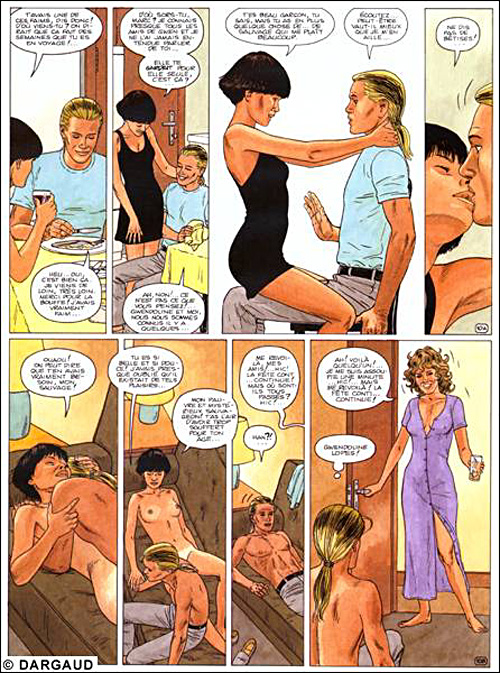
Aldebaran and Betelgeuse by the Brazilian and now France-based writer-artist Leo are two linked graphic novels, each of five parts. I referred to them in my piece on their UK publishers Cinebook (which, if you haven't read that post, I suggest you do before continuing). Since then I've read the complete series and I confess to having mixed feelings about them. There is a lot to like and a number of things which niggle or annoy me.  First off, some pictures. Some of these are from foreign language sources.


In the English language edition, and despite the 15+ rating, her top is covered up.

Before going into the story, I'll briefly discuss the art. I like the clarity of it. People look like people, unlike the superheroes of American comics. The young woman in the image immediately above is Kim who is the protagonist of the series, aging during the course of it from 13 to her mid-twenties. There's no difficulty in following the story, no attempts at 'clever' or 'arty' layouts.

Leo is also very good at picturing convincing Earth-like but still alien environments and populates with them with some wonderful creatures. I wish more images from the these books were available via Google so I could show you more examples.

There are very few narrative captions and those that are are from a character's point of view. Otherwise, all information is conveyed either through the visuals or through dialogue. And, dear lord, there is so much dialogue that sometimes I was wishing for more narrative to simplify things. With up to nine panels a page on a standard American comic size rather than the larger format of Orbital (see earlier post), the dialogue often squeezes the image, but then that's just two people talking anyway.

The planet Aldebaran is a water world, 90% to 10%. Humans have colonised it for over a century and haven't from Earth in all that time. As a result we have a predominantly rural but also patriarchal and authoritarian society. Our two protagonists, 13 year old Kim and 17 year old Alex, live on a coastal fishing village which is destroyed by some strange creature which may be highly intelligent but impossible to communicate with. They soon find themselves hunted by the authorities because of their contact with a man who had been investigating said creature. They meet a variety of people, grow up considerably and, though the mystery of the creature isn't solved, contact with Earth is restored and at the end their future looks bright.

In Betelgeuse set several years later, they find themselves on another lost colony. This time it's a desert world with another patriarchal authoritarian society living along the banks of a vast fertile and deep river valley while a few dissenters cling to life around the tops of the cliffs. Kim discovers that another of the strange creatures of the same species as the one on her homeworld also lives here. Again the problem is how to communicate with it.

This is almost a very good series and as I've said there's much to like about it. There is, however, too much repetitiveness. The patriarchal authoritarian government is a cliche as it is and to have two of them in succession smacks to me of laziness, lack of imagination, or just preaching and I find that they are more of an irritation in that they get in the way of the story. Kim herself is a good character but, from the time of her first period (and that was not a joke) absolutely every young male she meets (with the initial exception of Alex) falls in love with her, wants to fuck her, or more usually both. Alex doesn't have many problems that way either. Also, as I noted above, in nude scenes in the English editions the nipples are hidden usually by the clumsy addition of a bra or other top. Clearly we aren't as sophisticated as the French or Belgians.

Finally, the way the two series have been published is a bit odd. The first three volumes contain the five parts of the Aldebaran, the first series, with two in each book. Yes, I know that makes six parts. That's because the second series, Betelgeuse, actually begins in vol.3 of Aldebaran. Parts 2 and 3 of Betelgeuse are in vol.1 of the series, with 4 and 5 published as separate vols rather than together as you'd expect. Why didn't Cinebook publish the first 4 parts of the two series in 2 vols each with the part 5 as a separate volume? You'd still have the same number of volumes.

I know that there is another series in the pipeline called Antares and I'll certainly by it. I just hope there's a little more variation than in these books which, despite their flaws, I do recommend.